State Secretary Van Dam of Economic Affairs is making more than two million euros available for the first phase of a National Precision Agriculture Living Lab. In this living lab, the latest inventions, prototypes and technologies in precision agriculture can be tested in practice. Precision agriculture is already being used on a small scale in the Netherlands. What exactly is precision agriculture and what examples from Dutch practice are there?
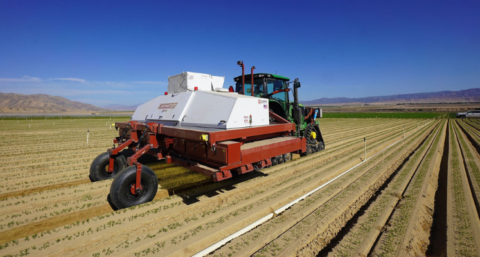
Precision agriculture is a form of agriculture in which technological tools help increase efficiency. Examples include using drones to detect plant diseases so that pesticides only need to be sprayed where they are really needed. Other examples are small agricultural robots that work the land efficiently and cheaply 24/7, sensors in the soil that provide automatic watering or fertilisation per plant and satellites that provide accurate information on soil fertility, harvest time or insect pests. These kinds of techniques can be tested in practice in the new National Precision Farming Experimentation Garden.
State Secretary Van Dam: "Dutch agriculture is an international leader. To remain so, we must invest in progress. That helps our farmers and market gardeners, and is good for our technology companies. With the knowledge and technology we are making ready for the market in the experimental garden, we can make agriculture and horticulture more efficient and sustainable. In this way, we can maintain our leading position and continue to contribute to the global task of producing enough food in the future."
Drone workers
Precision agriculture has been worked on and experimented with for some time in the Netherlands. The Dronewerkers collective, for instance, deploys sensors and drones to accurately map which crops need extra fertilisation. As a result, farmers know exactly where they need to fertilise more or less. This reduces fertiliser use and also benefits plot yields. Dronewerkers was set up by the Thijssen Payroll company in cooperation with AkkerAnalyse and Aurea Imaging.
AgriFly
Eppenhuizen, Groningen-based AgriFly is also focusing on using drones for precision agriculture. AgriFly focuses on 'crop health management' and helps farmers use drones to increase plot yields. The company gives farmers targeted advice based on data collected using its drones. In doing so, AgriFly focuses on questions such as:
- Why is planting, milling or spraying done on a certain day?
- Why is 250kg/ha of fertiliser applied instead of 150kg/ha?
- What effect does a different variety have on the yield of a plot and which variety is most suitable for a farmer's specific plot?

5Groningen Fieldlab
The 5Groningen Fieldlab is Europe's first rural 5G test field. In a field belonging to arable farmer Pieter van Maldegem from Vierhuizen, smart sensors have been placed that continuously measure the condition of the soil. For instance, the sensors measure soil fertility, moisture content and the condition of potatoes. The sensors are connected to KPN's long range (LoRa) network, which is specifically designed to connect devices such as smart sensors to the internet. Through this network, the measurement data are transmitted to a computer and analysed using a special programme. Thanks to the sensors, it is possible to accurately identify the perfect time to sow, fertilise and harvest.
In the next step, sensors will be placed underground and even more data will be collected, including on temperature and nutrients present. A number of arable farmers from the aGroFuture foundation will test the sensors in practice with seed potato crops during the growing season from May to October. 5Groningen is a programme of the Economic Board Groningen.
By: Wouter Hoeffnagel
Source photo: Kletr / Shutterstock, Inc.