Researchers at Ghent University (UGent) have succeeded in developing a protective coating for boats based on recycled crustacean waste. The coating will be extensively tested from July on a sailing trip around the world.
The protective coating consists of chitosan, a bio-based component made from crustacean waste. Naturally, the substance has a protective effect against fungi and bacteria. For example, it is also used in agriculture and for water purification, in the food and cosmetic industries, for suppressing sweat odour and for medical applications.
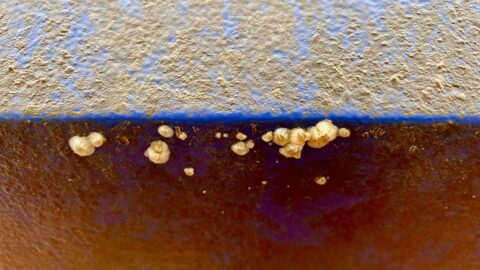
Professor Chris Stevens (Faculty of Bioengineering Sciences, UGent) and his team modified the material in such a way that it gained additional protective properties. Thus, the substance should be able to prevent the fouling of mussels, algae and barnacles on the hull of the sailboat.
Organic and recycled
"To combat this kind of fouling on boats, toxic products are usually used. We took on the challenge of tackling this in a more biological way so that there is no risk to the environment," Professor Stevens said. "Moreover, we managed to convert food waste into something useful, which allowed us to reduce the carbon footprint of this product to the maximum."
Sailing trip around the world
The special coating can soon be extensively tested in the water. In fact, it has been applied to part of the sailboat of sailor Erik Kiekens, who will leave Ostend on 8 July on a round-the-world sailing trip called Sailing Le Grand Bleu. During the trip, it will have to be seen whether the chitosander derivative is sufficiently protective against the growth of mussels, algae, barnacles and other fungi and bacteria. Kiekens is a former chemist himself and has been researching anti-fouling paints for years. Until now, however, these have contained toxic substances.
Among other things, he will therefore test UGent's product. He will also test his own formula, based on only natural ingredients. He has partnered with UHasselt and KULeuven to deploy nanotechnology for these te applications.
International network Green Chemistry
The researchers' coating is a stepping stone to the type of research that Ghent University wants to focus on with its brand new international network Green Chemistry: designing chemical products and processes that reduce the use of hazardous substances or even make them completely unnecessary.
This network brings together the expertise of chemists from universities around the world: York (UK), Toulouse (France), São Paulo (Brazil), Maastricht (Netherlands), Tennessee (US), Sichuan (China), Hong Kong (China), the Karlsruhe Institute of Technology (Germany) and Zurich Technical University (Switzerland). Coordination of the international network will be done by UGent.
The aim of the network is to provide education, research and services for companies on an international scale on sustainable chemistry, focusing on how green technology can be used in production and design processes.
The UGent researchers involved have years of expertise in natural products, microreactors (small flow-through reactors) and reusable raw materials to develop chemical building blocks for new materials.
By: Kelly Bakker
Source: UGent
Photo: Pixabay