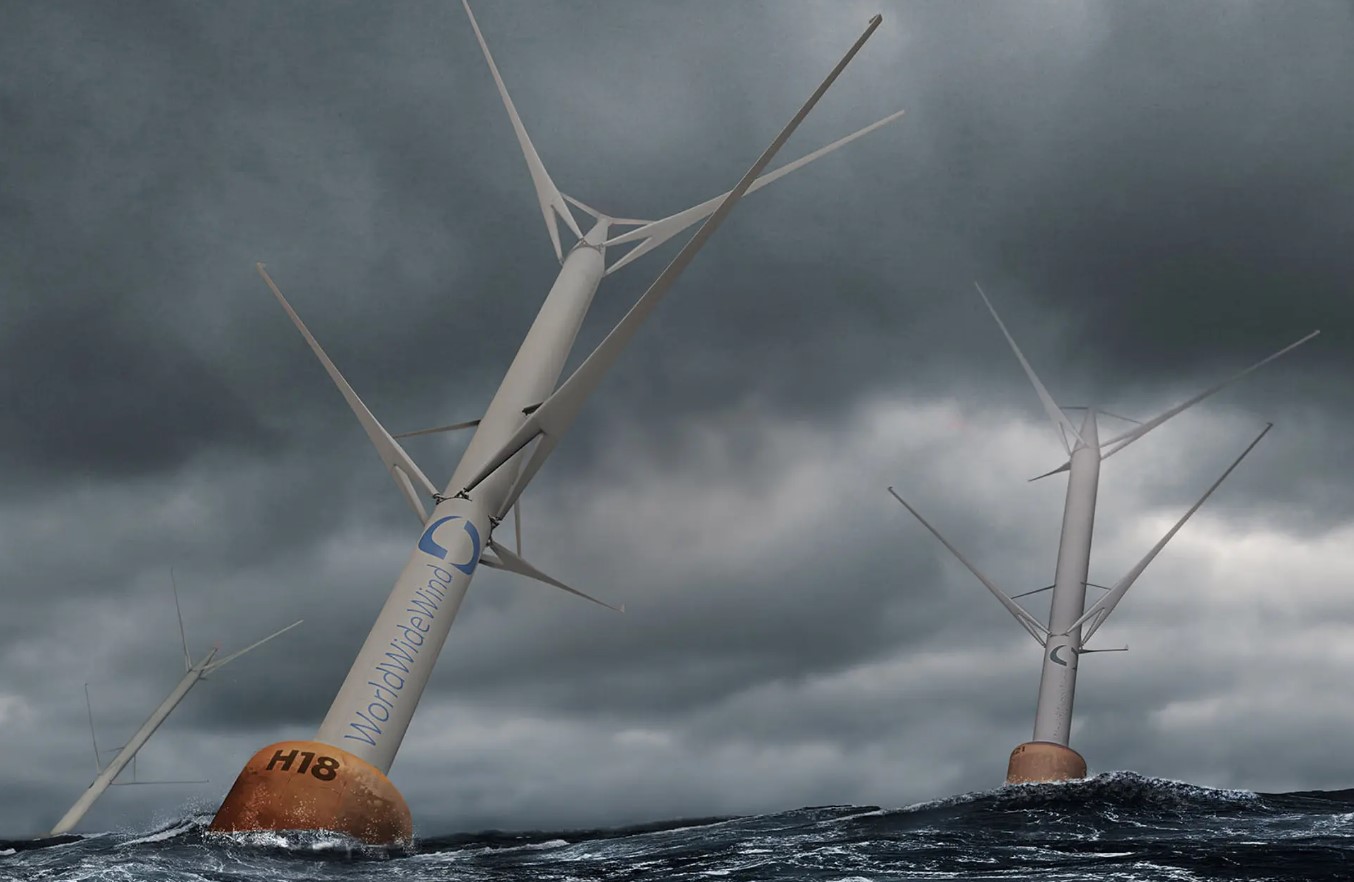

A highly innovative turbine that could halve the cost of offshore wind power is being tested in Norway. The 19-metre-long, contra-rotating vertical-axis turbine is a prototype design that could be scaled up to unprecedented size and power.
Most wind turbines look like a propeller on a stick. That works very well, but as soon as you scale up the concept and take it to the deep ocean, where wind is available in large quantities, the design makes less and less sense. All the heavy components are on top, so it is difficult and expensive to build a floating version that doesn't topple over and is easy to maintain.
Twice more power generation
That is what makes World Wide Wind’s counter-rotating floating wind turbines so fascinating. All the heavy work is at the bottom – underwater and beneath the turbine’s floating pontoon. This adds sufficient weight at the bottom, meaning only a set of anchors is required. With this new wind turbine, twice as much electricity can be generated and the cost of the generator can be halved. This makes the system more scalable. Because the turbine is maintained at the bottom rather than hundreds of metres up in the air, maintenance is also cheaper.
Counter-rotating turbine
The generator’s rotor and stator are connected to a pair of vertical-axis turbines, each with three blades at an angle of 45 degrees to the tower’s main axis. The lower turbine is set to rotate in one direction whilst the upper one rotates in the opposite direction. Thanks to a clever design feature, the dual, counter-rotating wind turbine always tilts to an optimal angle, regardless of the direction from which the wind is blowing. Because the two turbines rotate in opposite directions, the speed at which the rotor turns within the stator is effectively doubled.
Lower wake effect
The torque exerted on the structure by the wind is effectively neutralised by the two opposite rotations. Furthermore, the conical sweep of each rotor reduces the speed at the point of intersection and produces a smaller wake effect, meaning the wind turbines take less ‘wind out of each other’s sails’. In practice, this means the wind turbines can be positioned closer together. This means that more energy can be generated from a given area and fewer cables need to be laid.
Smart material choices would allow the turbines to be scaled up to a height of 400 metres, according to World Wide Wind. A single turbine could thus generate 40 MW - almost twice as much as the world's largest wind turbines currently do.