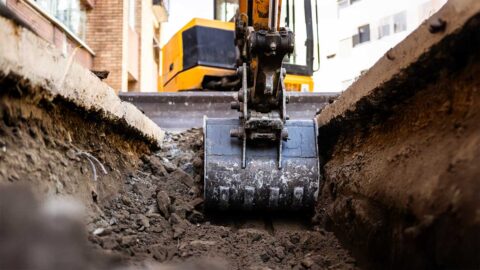
How can you make the laying of asphalt data-driven to optimise construction and make lifetime predictions? A newly-laid road on the University of Twente campus will have built-in fibre-optic sensors for measurements during construction and use of the road. It is a Living Smart Campus project led by Seirgei Miller of the Faculty of Engineering Technology.
The trial on campus is part of a larger project, in which almost all major road construction companies are participating, for professionalisation of the sector. It is called Asphalt Paving Research & Innovation (ASPARi) and is led by prof.dr.ir. André Dorée, Dr Seirgei Miller and Dr Farid Vahdatikhaki of Construction Management & Engineering.
Data
"Laying asphalt is a process with a lot of implicit knowledge still present in 'the team' working on the road," explains Seirgei Miller. "By collecting data immediately, we can adjust the process in real time and give new instructions to the road workers. And we can link this data to longer-term road behaviour." The researchers are doing this for a reason: road authorities are making increasing demands. Whereas in the past a warranty period of three to five years was sometimes used, it is now more likely to be seven to 10 years. Together with his students, Miller has therefore already measured a lot during the laying of the asphalt. For example, by deploying a combination of high-resolution GPS, cameras and infrared scanners. "We do know a lot about asphalt products, in the lab we can put together optimal mixtures. But conditions during laying can be decisive for frost resistance, for example. Also, stresses can already occur at that time, leading to faster wear."
To measure is to know
The renewal of some roads on the UT campus, prompted us to look into the possibility of placing sensors ín the asphalt as well. These start measuring as soon as the last layer is put on, and also continue measuring once the road is loaded. "The campus is a nice environment to test this out. Clients are, normally, reluctant to place this kind of measuring equipment in their asphalt layers. We do have measurement sites in the region, but those are RFID sensors that you have to read on site. That is cumbersome, and not so safe in heavy traffic. Thanks to Living Smart Campus, we can indeed install fibre optics and RFID sensors in these roads."
The fibre optics sensors installed in the road can be continuously read remotely. They are resistant to high temperatures and can measure the temperature of the asphalt during freeze-thaw cycles, and, for example, deflection under load. Asphalt layer temperatures are also monitored with a number of RFID sensors and compared with fibre optic data.
Already during laying, the new sensors have provided a wealth of information. Now it is exciting to see how the road behaves in the coming years, and whether this behaviour can be traced back to the conditions during construction. The UT campus is a great test environment for this, ASPARi is therefore going to yield great research projects for students in the coming years, according to Miller.
Source: University of Twente