Alongside the growing popularity of autonomous vehicles, autonomous vessels are also on the rise. Autonomous cargo ships, ferries and even electric container ships are set to make their debut in the coming years. At the same time, large-scale experiments are being carried out with vessels powered by solar panels. In many cases, the design of the hull and the propulsion system remains more or less unchanged. The AutoNaut is an exception to this. This vessel is equipped with solar-powered sensors that monitor marine life and ocean conditions. However, the vessel is propelled using energy harvested from waves.

The history of the AutoNaut goes back to 1981 when a skipper wondered if it would not be possible to power his schooner with the movement of waves. From this, a prototype was created that demonstrated the viability of the idea. Despite this, the plans disappeared into the closet for over 20 years before the skipper came up with the next step: a hull specifically designed to be powered by waves. The idea was commercialised in 2012; a 2-year refinement of the technology was recently completed. During that testing period, navigation, steering and remote data collection were improved.
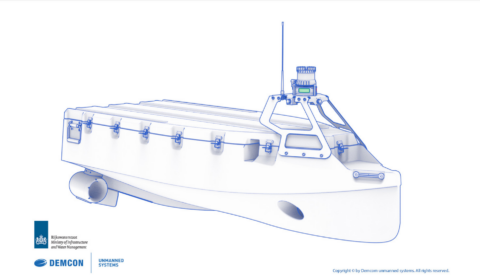
Earlier this year, a new 5-metre-long unmanned vessel packed with sensors was presented. The vessel's keel is fitted with spring-loaded sheet metal that can extract energy from the up and down wave motion and convert it into thrust. The design is such that the thrust is delivered independently of the wave direction; the speed achieved is about 5 knots.
Solar panels on the top of the deck power the sensors. The data thus captured and processed are then sent to shore via a satellite link. The same satellite link can in turn be used to control the vessel. The video below demonstrates the development of the AutoNaut.