Just over 20 seconds it takes 'em to pluck a fresh sweet pepper from the plant: the Sweeper robot. This robot, developed by a consortium of several experts, could be a good solution for sweet pepper growers facing a shortage of personnel.
It is a common problem among growers: a shortage of staff. There are fewer and fewer people willing to do the repetitive work in the first place, and when they are there, they are relatively expensive. Eye robots offer a good alternative and are now being made on a small scale, such as the asparagus robot by Dutch company Cerescon. Now a Dutch consortium, which included Wageningen University, has developed a pepper eye strobot called the Sweeper. It was demonstrated live a few months ago and is now in full development.
90 seconds
As part of the Crops project, developers already built a pepper picking robot a few years ago. It became a system that could detect the peppers, take 3D images, assess their colour and shape and pick the ripe peppers. The robot picked about a third of all ripe peppers and took an average of 90 seconds to do so. Quite fast, but not fast enough in the eyes of many growers, as humans pick a pepper in about six seconds.
Researchers and developers from Belgium, Israel, the Netherlands and Sweden launched a follow-up project in early 2015, led by Wageningen University & Research. This Sweeper consortium receives financial support from the Horizon 2020 programme and the Top Sector Horticulture & Starting Materials.
Demonstration
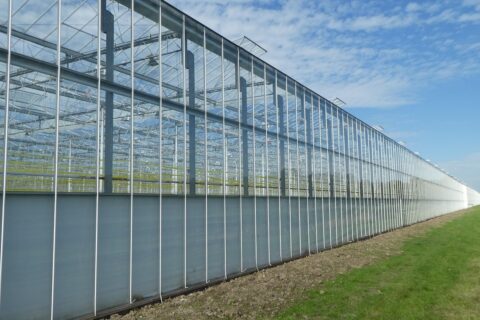
It was the first pepper harvesting robot to be demonstrated in the world in a commercial greenhouse. The robot was designed to work in a cultivation system with single plant stems in a row, a crop without clusters and with little leaf coverage for the fruit. Tests were conducted in a commercial greenhouse with a V-type, double-row cultivation system. Preliminary results of tests with a commercially available crop adapted to the required conditions show that the robot harvests 62% of all ripe fruits in 24 seconds. Based on these results, the Sweeper consortium expects a commercial pepper harvesting robot to be available within 4-5 years.
Further research is needed to make the robot work even faster and achieve a higher success rate. Currently, the robot still often needs too much 'thinking time' because certain aspects are not yet in parallel. Next, a commercially viable single-stem row cultivation system needs to be developed and breeding companies need to develop cultivars that are more suitable for robotic harvesting.

Mechatronica Machinebouw, which interviewed WUR project coordinator Jos Balendonck, tells us more about the technical aspects of the robot. For instance, the Sweeper has colour images and a depth map to detect the peppers. For this, the consortium found a camera system in Sweden. It also uses short flashing LED lights. This is to ensure that sunlight does not interfere with the image quality. The camera, which views the peppers slightly from below, achieves a detection score of 89 per cent, according to Balendocnk.
The Sweeper then approaches the pepper and cuts it loose. For this purpose, a gripper concept was developed over the years with a small vibrating blade that cuts the stalks from above.
Cucumbers
The Sweeper is now suitable for yellow peppers. Because the detective goes by colour, in theory it should also distinguish orange and red peppers. Green, in turn, is more complicated, thinks Balendonck. To Mechatronica Machinebouw, he says: "We built a cucumber picking machine in the past. Because cucumbers are 99 per cent water, we looked at the crop with spectral bands and were able to register bags of water. That won't work as well for peppers, so we have to rely on machine learning there. We haven't tried it yet, but I expect it will work.'
Anyway, the technology from the Sweeper robot is reusable for harvesting systems of other vegetables and fruits. It consists of a variety of modules, such as the deep learning algorithms, the cutting tool and the Ros software for controlling the robotic arm that can also be used for other crops.
The Sweeper project officially ends on 1 November. Before that, the robot will be demonstrated live one more time on 12 September.
Source: Sweeper/Mechatronica Machinebouw