Dutch start-up Voltogo has developed a plug&play set with battery and motor and a network of fast charging points with which it wants to make it easier for boat owners to switch to electric boating. The company is thereby capitalising on the stricter requirements for pleasure boating.
What is Voltogo?
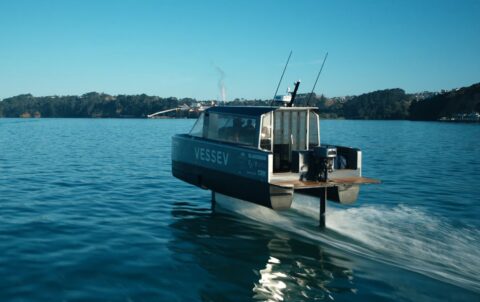
Voltogo makes a combination of an electric motor and a battery that allows you to convert a sloop (up to 8 metres or so) into a 'Tesla' on the water, we read on Sprout, which bombed Voltogo as start-up of the week. Like Tesla, Voltogo is building a network of fast charging points, the first four of which went live in Amsterdam last week. "We want to make electric cruising a party, instead of that old petrol drivel," co-founder Job Veltman tells Sprout.
With electric boating, the company of Veltman and co-founder Folkert Roscam Abbing is capitalising on a trend partly fuelled by the government. In Amsterdam, for instance, all pleasure craft must be fossil-free by 2023, which in practice means electric. Utrecht has introduced such electric measures, while in a series of nature reserves electric boating is gradually becoming mandatory.
A key mission of Veltman and Roscam Abbing is to combat range anxiety, or the fear of running out of power. For that, it is important to be able to see clearly how much juice is left in the battery. Something that Veltman says often leaves something to be desired with existing batteries.
Cells
Voltogo uses the same kind of battery cells as in a Tesla, which have become a lot cheaper thanks to that car company's scale. While a Tesla battery consists of 7300 cells, a Voltogo battery has 200.
"With batteries, the most important thing is to give people control over what energy they have left. Then it no longer feels scary at all to run out." Voltogo therefore developed an app - a screen on the motor is often not easy to read - that allows you to clearly see how much energy you have left. Depending on the size and weight of a boat, a Voltogo battery provides around 4.5 hours of sailing time.
Founders
Co-founder and TU Delft engineer Job Veltman previously co-founded a robotics company for building offshore wind turbines. He came up with this idea while sailing across a lake in Myanmar. "All those little boats criss-crossed the lake, not making long trips. Then a relatively small battery is all you need, provided you can swap or fast-charge it."
Veltman hooked up co-founder Folkert Roscam Abbing, an electrical engineer also a TU Delft alumnus. Roscam Abbing previously worked at fast charger maker Epyon, the Dutch company acquired by Swiss company ABB in 2011. He is also still involved in Ampyx Power, a Dutch company that generates wind energy using kites.
The two entrepreneurs started developing a universal battery that could fast charge last year. The concept soon expanded to a complete set. "We as soon came to the realisation that people are looking for a motor, not a battery," says the entrepreneurs.
Target
And who want to experience and show what it is like to sail electrically and silently. And, of course, all boat owners living in areas where electric boating is becoming mandatory. The target group is initially anyone with a sloop up to about eight metres, with an outboard motor. That amounts to some 400,000 boats in the Netherlands.
Next year, Voltogo also plans to launch a package for larger boats, including inboard motors. In doing so, the startup is also looking across the border, To Finland, for example, which with 1.9 million pleasure boats is the European leader in boating. "We want to become the standard for electric recreational boating."
Pre-sale
After an initial test run last March, sales officially started last week, launching the first network of four fast-charging points in Amsterdam. "The pre-sale is over, from now on the really hard work starts to make sure we will be at every major water sports shop," said Mr. K. The goal is to sell 5,000 Voltogo sets in the Netherlands and Belgium next year.
Business model
Individual system sales. The cheapest (portable) set costs 2900 euros, a premium variant with more power costs 4900 euros. To get the first group of buyers over the threshold quickly, they are allowed to tap power for free for life at Voltogo charging points.
Voltogo leases its fast chargers (per season) to hospitality entrepreneurs. Sloep-owners can also use their app to see where charging points are. where they can also be presented with offers to drink or eat something there (although there is no revenue model in that for now, says Veltman. It is still mainly an extra service'). In addition to online sales, Voltogo is looking for the old-fashioned retail market, To convince buyers that the system works and that it looks good, the company stores demo sets at major water sports shops.
Veltman and Roscam Abbing managed to bootstrap their company so far, albeit with the help of a modest innovation grant from the European Union, through the Climate-Kic programme. "Those combine coaching and money without too many preconditions, which you usually can't meet as an early stage startup."
Source: Sprout/Voltogo