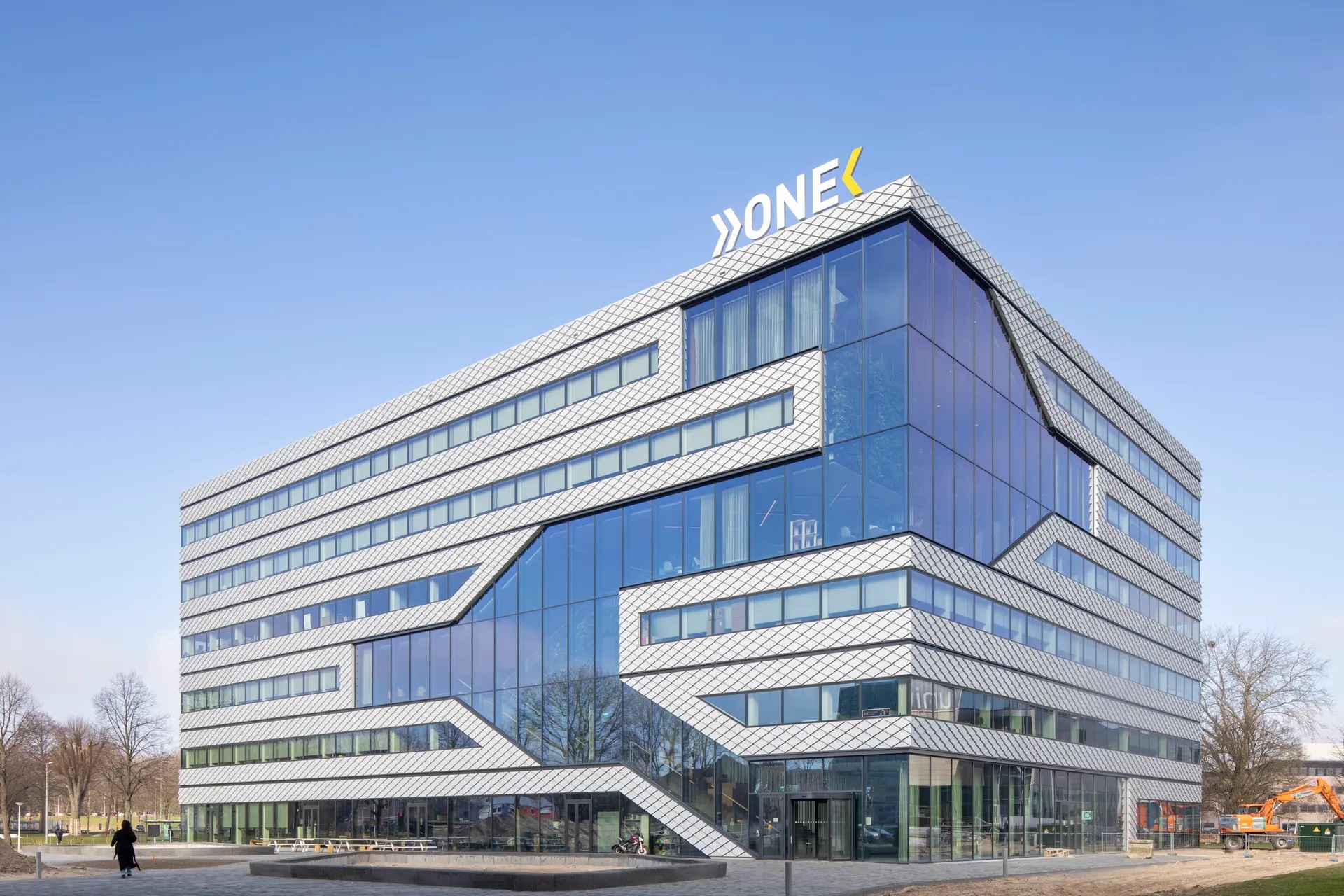

The energy-efficient Matrix One laboratory and office building in Amsterdam was recently completed by MVRDV. The building is designed for flexibility and features a demountable construction. As a result, more than 90% of the building materials can be reused.
Matrix One
Matrix One is the largest of seven buildings that make up the Matrix Innovation Center in the Amsterdam Science Park. In the park, scientists and entrepreneurs work together on sustainable solutions to current and future problems.
The 13,000-square-metre interior is spread over six floors and houses a mix of laboratories and offices for tech and sustainability companies such as Qualcomm, Photanol and Skytree. It is also designed as the social hub of the surrounding campus and features a large "social staircase" with multiple seating areas and tables for informal meetings and coffee breaks. Other notable interior design elements include green walls and a soft felt finish to reduce sound reflection. A spacious central atrium is naturally lit with large skylights. Elsewhere on the ground floor are a restaurant, bar and 100-seat auditorium.
Demountable construction
MVRDV spared no expense to ensure that Matrix One can be dismantled and reused again if necessary. For example, screws and bolts to fasten the building together are easily accessible and the air ducts have been left free for maintenance. All internal walls can be moved or removed, allowing different layouts as requirements change. Crucially, an online materials database was used to keep track of the approximately 120,000 building components and their (re)usability for future use.
Matrix One provided MVRDV with an excellent opportunity to test a number ofCO2 reduction strategies. The building is currently state-of-the-art, but that concept is also subject to change. Therefore, MVRDV made both the interior spaces and the associated technical installations as flexible as possible; offices can easily be converted into laboratories and vice versa, and laboratories can easily be extended with new systems to meet changing standards. In the decades to come, when the building is no longer state-of-the-art, it will become a resource to harvest materials from for other buildings.