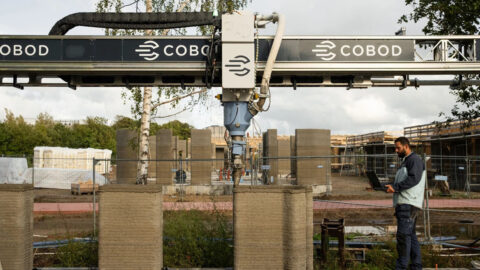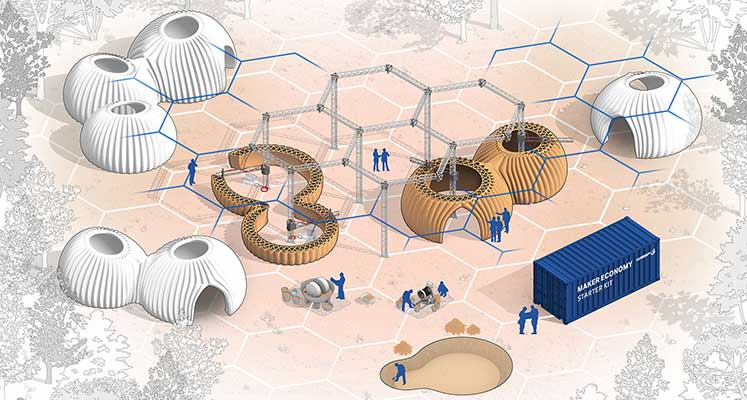

Sustainable building and circularity are common terms. Increasingly, builders are achieving wonderful results. In Italy, for example. There, 3D Wasp developed a 3D printer that uses materials found near the construction site. Insulation material: rice waste.
Rice is grown all over the world. Consequence: when it is processed, a lot of rice straw is left behind in the fields. Often, the material is burnt on site. Italian RiceHouse is therefore working on the sustainable processing of the residue into building and insulation material.
Interesting collaboration
3D Wasp and RiceHouse (IT) have entered into an interesting collaboration; Gaia (goddess of earth and Greek maiden name meaning earth ed.). Earth is the main binding agent of the mixture 3D Wasp uses to print. It is mined near the construction site and mixed on site. A key 'ingredient' is rice waste, supplied by RiceHouse.
Vegetable fibres
For the realisation of Gaia, RiceHouse supplied the plant fibres with which WASP developed a compound consisting of 25% soil from the site (30% clay, 40% silt and 30% sand), 40% rice cut from straw, 25% rice husk and 10% lime. The mixture is blended through the use of a muller, making it homogeneous and workable.
Indoor climate
The method of production, the thickness of the walls and the materials used create favourable climate conditions. According to the manufacturers, even such that heating and/or air conditioning are unnecessary. The house has a "mild and comfortable indoor temperature. Summer and winter."
Deployable worldwide
Raw materials for this type of house, with this composition are available in abundance worldwide. The printer, Crane Wasp and the technology are accessible and easily available. 3D Wasp and RiceHouse are therefore betting on a rapid global rollout of these highly sustainable and circular homes.