Van Oord orders a second unmanned and autonomously sailing inspection platform from Demcon unmanned systems. The platform will be used to carry out hydrographic inspections for measuring soil profile, among other things.
Van Oord says the use of unmanned and autonomous vehicles for hydrographic inspections is necessary as manned sounding boats cannot be used everywhere due to space or environmental constraints. For example, in construction pits, drinking water basins and nature reserves, manned vessels are often not applicable. Unmanned and autonomous vessels can be smaller and therefore offer a solution. Among other things, they enable remote, cost-efficient, automated and digitised operations.
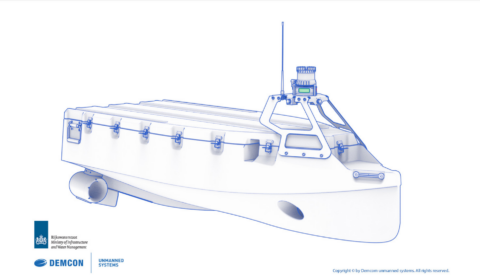
DUS V2500 platform
Demcon unmanned systems is responding with specially developed unmanned and autonomous sailing inspection platforms. The platform in question is the DUS V2500 platform, which sails fully electrically. The platform has been in use by Van Oord for some time; the company is now ordering a second copy of the unmanned inspection platform. The platforms are equipped with intelligent controls. A standardised system architecture is also used. Algorithms and software are deployed for autonomous control. Sensor fusion and data processing also take place in real-time.
"The control of our platform is very precise, thanks in part to our navigation technology and patented positioning system," says Fedor Ester, managing director of Demcon unmanned systems. "The modular platform is fully customisable to the user's integration requirements or system needs, for a variety of applications and environments."
The DUS V2500 platform was developed by Demcon unmanned systems in 2020. The platform is only 2.5 metres long. That is considerably smaller than a manned survey boat, which is about 8 metres long. According to Demcon, the data quality provided by the platform is not inferior to that of existing assets. The system was recently certified to gather hydrographic data for Rijkswaterstaat.
Widely applicable
Ester: "Our DUS V2500 platform is widely deployable because it is small and light, has less draught and features autonomous navigation technologies. The system has full control over movements on the water, allowing manoeuvring with high accuracy, even at low speeds. The limited number of moving parts (no rudder, no rotating thrusters for steering, ed.) make it a low-maintenance system. The electric drive system operates without fluid, is emission-free and low-noise. Together with the (Kiwa) drinking water certified hull coating, it makes it an environmentally friendly piece of equipment with minimal impact on flora and fauna above and below the water table."
The first version of the platform already in use by Van Oord focuses on inland waterways. The platform now ordered is also suitable for near-shore operation. "Van Oord is also more broadly interested in the application of our platforms and autonomous navigation solutions, for example to give a captain better visibility around his vessel," he said. The second platform is not only intended for inland waters but also for near-shore use. Therefore, the hull is slightly modified for better positioning in waves and the system architecture gets additional redundancies. The small automatic winch that lowers sensors underwater has also been optimised for better and accurate operation at greater depths," Ester explains.
Modularly built
"The architecture of our vessels is modular, so we can easily build a larger or smaller version or realise a different application. We only need to scale the geometry of the hull and components and integrate application-specific sensorics and software. We are in talks with parties for deployment of our systems in offshore wind farm construction and management, among others. Waves are higher there, limiting the time window for manned vessels for safety reasons. With our solution, surveyors can safely remotely control the operation of their platform, or even several platforms simultaneously. Our unmanned vessels increase efficiency and safety."
Demcon reports on its website that its so-called Unmanned Surface Vessels (USVs) are suitable for a variety of applications. The system can be customised on March and tailored to customers' specific management needs. Also, the payload the vessel can carry and the presence of sensors can be tailored to the application.
Unmanned Aerial Vehicles
Besides USVs, Demcon unmanned vehicles also focuses on the production of Unmanned Aerial Vehicles (UAVs). For instance, the company offers the Mule UAV platform, a modular test and development platform. Using the Mule UAV, users can test features in flight and performance in different applications of sensors and different payloads. Demcon reports that the hardware and software architecture is easily adaptable and can be fully customised.
Author: Wouter Hoeffnagel