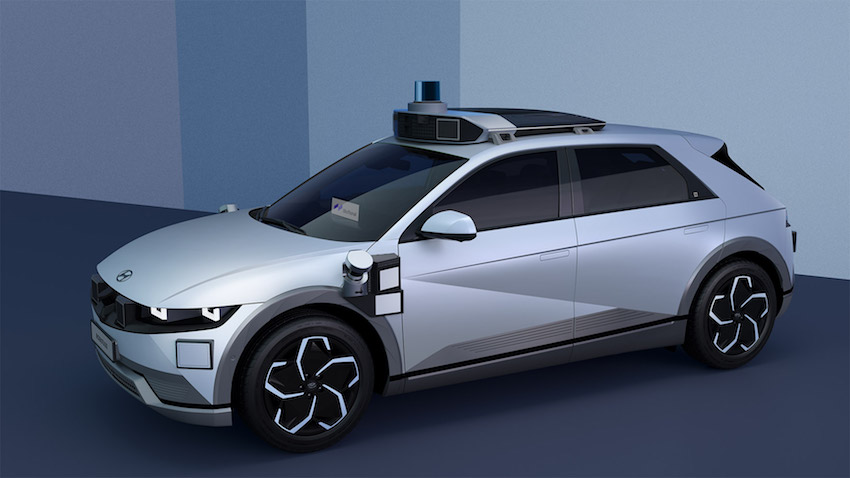

Hyundai presents the IONIQ 5 robot taxi. The vehicle is based on the all-electric IONIQ 5, is on the new Electric Global Modular Platform (E-GMP) and offers level 4 self-driving capabilities. This gives the vehicle a high degree of autonomy.
The IONIQ 5 robot taxi was developed by Hyundai in collaboration with Motional. This is a joint venture between Hyundai and Aptiv, a supplier of automotive technology. Motional is focused on developing autonomous driving technology. By combining electrification and autonomy, the parties aim to make passenger transport smarter, safer and more sustainable.
Level 4 autonomy
The vehicle offers Level 4 autonomous driving capabilities, Hyundai reports. The US Society of Automotive Engineers (SAE) defines this level of autonomy as follows:
- Drivers no longer drive their vehicle autonomously if this feature is enabled;
- The automated driving functions do not require the user to take over the controls;
- The vehicles can be used locally as a driverless taxi;
- In some cases, commutators and a steering wheel are no longer present.
Hyundai is aiming for the IONIQ 5 robot taxi to be deployable for passenger transport from 2023. To this end, the company has partnered with taxi platform and self-driving car technology provider Lyft.
Remote operator looks on
Although the vehicle can drive largely autonomously, an external Motional operator is watching. If the robot taxi is faced with an unusual traffic scenario, this operator can intervene and direct the vehicle to a new route. Think of flooding or roadworks.
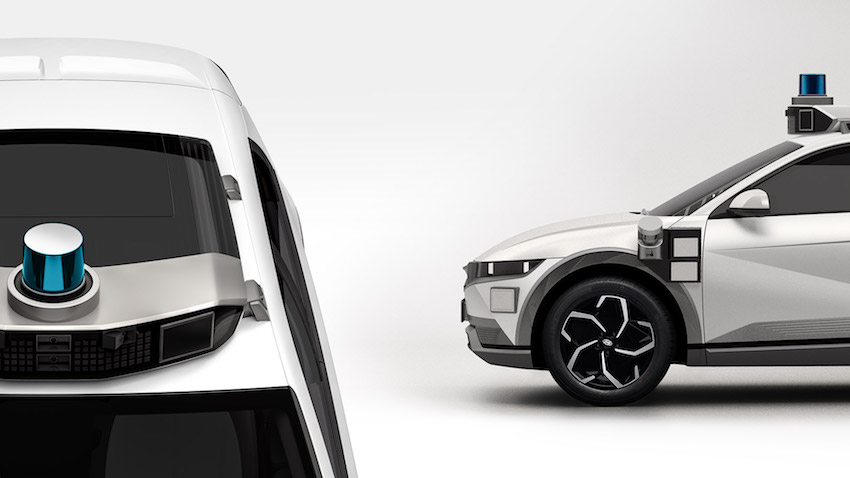
The robotaxi can use over 30 sensors during autonomous driving. These include a combination of cameras, radars and lidar sensors. The combination gives the vehicle 360-degree visibility. The IONIQ 5 robot taxi is based on the E-GMP, a platform that forms the basis for Hyundai Motor Group's new generation of electric vehicles. Besides Hyundai, this includes Kia, Genesis and IONIQ. The group aims to introduce 23 BEV models of which 11 will be fully electric based on the E-GMP platform by 2025. More than 1 million BEVs should be sold worldwide by then.
RobotShuttle
The South Korean carmaker has been betting on self-driving cars for some time. In July, for instance, the company presented the RobotShuttle. This autonomous passenger bus provides an almost entirely autonomous shuttle service between a number of stops in the South Korean city of Namyang. The vehicle is based on Hyundai's H350, a light passenger bus with four doors. The vehicle features a "number of core systems is applied at level 4 of autonomous driving". This enables the vehicle to perceive its surroundings, make decisions and drive itself on public roads.
Unlike the robot taxi, the RobotShuttle always has a driver riding along. Hyundai reports that it provides "minimal assistance" in driving the vehicle. The autonomous H350s travel along a 6.1-kilometre route, making 20 stops. Booking a seat on the shuttle bus can be done via a mobile app called 'Shucle' from AIRS Company. This is Hyundai's specialised artificial intelligence research lab.
Author: Wouter Hoeffnagel








