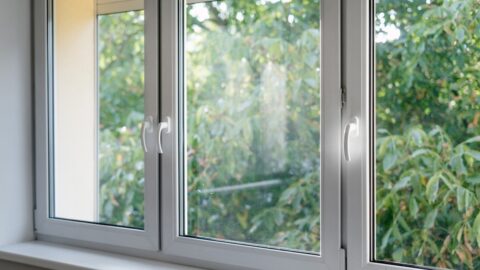
There are already several types of 'smart' glass; smart, glass windows that can be coloured electronically to keep out heat from the sun. This in turn saves air conditioning costs. There is just one small caveat to these electronic solutions: they also require electricity. Researchers from Australia have now developed a coating that makes existing ordinary glass windows smart without the need for electricity.
The self-regulating coating consists of the relatively cheap vanadium dioxide and is applied in a 50-150 nanometre layer. That is about 1,000 times thinner than a human hair. At a surface temperature below 67ºC, vanadium dioxide acts as an insulator. This prevents heat from escaping through the glass while allowing the full spectrum of sunlight to enter. At temperatures above 67 ºC, vanadium oxide turns into a metal that keeps out the sun's infrared radiation.
This means that a room stays warmer at low temperatures while staying colder at higher temperatures. In this way, heating and air conditioning systems need to be used less. Should the user still wish to do so, the blocking effect of the coating can be switched off with a dimmer switch.
Whereas until recently special procedures were needed to apply vanadium dioxide coating, it can now be applied fairly quickly and easily. The team of researchers developed a special method for this, which they hope can now be made commercially.