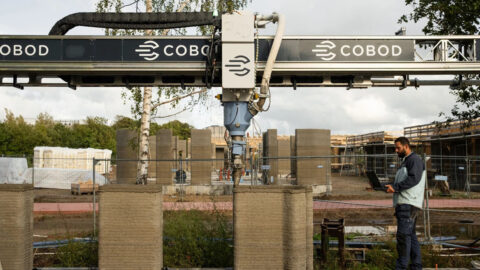
At Eindhoven University of Technology, 3D printing of concrete has been pioneered for many years. Currently, architect Zeeshan Yunus Ahmed is working on 3D-printing reinforced concrete. Among other things, a transport screw from Van Beek forms an important part of the new 3D printer that will be used for this purpose.
In 2017, TU/e delivered a new cycle bridge produced by a 3D printer, and last year Nijmegen was the first in the world to unveil the longest 3D-printed concrete footbridge (28 metres), also originating from Eindhoven. Zeeshan Yunus Ahmed, a researcher at TU/e, is now working on the next step: 3D-printing reinforced concrete. To develop a prototype printer, Ahmed’s research team opted, amongst other things, for a screw conveyor and the expertise of Van Beek, a specialist in screw conveyors.
Reinforcing concrete
Concrete is a brittle material that can handle a lot of compressive force but little tensile force. To prevent cracking, it is therefore important to reinforce concrete with rebar. This prevents the foundation from cracking in case of an earthquake or ground subsidence. Now, cement as used in 3D printing is mostly unreinforced and therefore unsuitable for construction of large or tall buildings. "Reinforcement is needed to hold concrete together, but this is not possible with a concrete printer. Therefore, we mix special fibres through the cement, which give the concrete the ductility needed for a sturdy building. At the same time, the special fibres hold the concrete together so that it does not crack," Ahmed explains in a press release from Van Beek.
Expertise
Fibre-reinforced concrete requires a new kind of concrete printer. Ahmed set out to find a way to dose the concrete, one of the most important factors of a 3D printer. Especially in the case of reinforced concrete, where dosing the cement as optimally as possible ensures the strength of reinforced concrete. The researcher ended up with Van Beek's conveyor screws: "Van Beek has great expertise in the field of conveyor screws. They were immediately enthusiastic and extremely helpful, interested and motivated to contribute to innovation." Joram van der Heijden, Sales Engineer at Van Beek, is also grateful that the TU/e knocked on Van Beek's door: "It is very important for us to share our knowledge with upstream industry. We are therefore happy to collaborate on projects of courses."
Next step
Besides the completed 3D printed bicycle bridge and pedestrian bridge, the construction industry is currently working on 3D printed houses. Nevertheless, the mass deployment of 3D concrete printers for the construction industry still seems to be futuristic. "The research takes a lot of time, in fact we have only just started. Building with concrete has been done for centuries, in fact, reinforced concrete has been used for more than 150 years. We have only been exploring this new form of building with 3D concrete printers for about five years."
Now that the prototype of TU/e's new 3D concrete printer is just about ready, it is time for the next step: a collaboration with the construction industry. There too, Van Beek hopes to play a role with her expertise.
Source: Van Beek