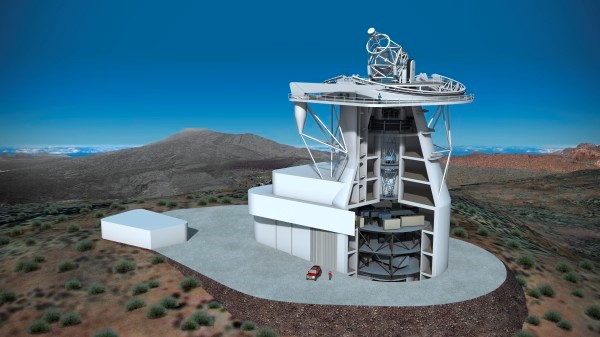

The development and construction of Europe's largest solar telescope European Solar Telescope (EST) is in full swing. TNO starts designing a key component of this telescope: adaptive mirror technology. Thanks in part to this technology, detailed studies of the sun will become possible.
The sun is not only an indispensable source of light and heat. With its powerful magnetic fields and complex atmospheric dynamics, the sun also has a huge influence on modern technology. Think satellites, aircraft, GPS and more. It is important that we can properly understand and even predict the constantly changing dynamics of the sun. It can help us ensure that it does not disrupt or destroy our essential technology.
Bringing the sun into sharp focus
Instituto Astrofísica de Canarias is leading the project to get a better picture of the sun. The researchers want to get the clearest images of the sun and solar activity. This is not just about the larger sunspots and flares. Smaller events and changes should also come into focus. This will require powerful telescopes and precise technology. In particular, the solar telescope will use an adaptive secondary mirror (ASM) that can quickly change shape. Earth's atmosphere causes optical distortion of solar images. The ASM corrects this distortion.
Drive system
Researchers place adaptive mirrors on actuators. This allows them to change shape to achieve optimal brightness. But current technology for these drives is fragile, energy-inefficient and difficult to control. TNO therefore developed an innovative new design that makes the drives accurate, robust, predictable and much less energy consuming than the best drives to date. TNO's propulsion system is ten times more efficient than traditional systems, yet enormously precise and effective. TNO's ASM is tunable to the nanometre. It delivers the sharpest possible images of the sun, all at a lower cost compared to current technology.
Preliminary design
The project is currently in the design phase. In this preliminary phase, TNO will prove that the concept for the EST ASM is feasible. TNO will partner with VDL ETG to build the drives. This is not the first time TNO and VDL ETG have collaborated on this revolutionary technology for telescopes. In 2019, as part of a joint investment with the University of Hawaii, the team designed a 63-centimetre-diameter ASM as an upgrade for the UH88 telescope in Hawaii. That ASM, currently under construction, will be actively shaped by 210 drives.
2000 drives
For the EST, TNO plans to design a mirror with a diameter of 86 centimetres and 2000 actuators. This is needed to enable the most precise motion and actuation. The team has also built deformable mirrors for the European Space Agency and the University of California's Center for Adaptive Optics. 'TNO's innovative science provides industrial and manufacturing opportunities for precision companies like VDL,' says Hans Priem, business manager of VDL ETG. 'We look forward to developing, manufacturing and bringing this exciting innovation to market together.'
Roadmap for the future
Kees Buijsrogge, director of Space & Scientific Instrumentation at TNO: 'We are very proud to have been selected for this preliminary design study and to strengthen European space science with genuine Dutch innovation. The interest of the EST project and its project office in our adaptive secondary mirror proposal is an important step towards achieving our goal of providing the world's leading observatories with the technology that brings the universe into sharpest focus. If this project succeeds, our adaptive secondary mirror technology will be a significant improvement on the current static secondary mirrors in the world's leading telescopes, such as Keck, Gemini, TMT and more.'
Combining forces
Christoph Keller, renowned solar astronomer and professor of Experimental Astrophysics at Leiden University: 'It is great to see European organisations joining forces on solar physics projects.' The construction of the EST in the Canary Islands will allow us to see the sun in more detail for longer periods of time, and that is essential to understanding our sun.'
Image: Illustration of what the European Solar Telescope will look like (source: IAC)











