It is more time than ever for the manufacturing industry to pay attention to online marketing and sales. At least, so argues Steve Vaughan of HubSpot. 'The world is changing and the question is: if you don't take action now, when will you?'
The topic is discussed in detail during a webinar organised by HubSpot and Webs on online sales & marketing for the manufacturing industry. Thijs van Rosmalen of Webs initially cites the key characteristics/pain points faced by manufacturing companies. These include global sales. Operating in a niche market. Possessing knowledge not easily found elsewhere. A long sales cycle (of 6 months or more). And having to influence multiple people per deal (CEOs, engineers, buyers). That these have become especially hefty challenges and perhaps even pain points in recent months is, of course, due to the lockdowns caused by corona. Travel became virtually impossible a few months ago. Important sales moments, such as trade shows, were moved or cancelled worldwide.
See also: ‘As a manufacturing company, you need to make your voice heard online too’
As a result, many account managers etc were no longer able to contact prospective prospects in that way. What, as Webs puts it, did not change, however, is how prospects continue to search for information. It was precisely because of corona that internet traffic increased and people searched online. Webs also points to the fact that, according to research, 70 per cent of the 'buyer journey' starts before a prospect interacts with sales. In short, it starts the moment they start looking for more information about your manufacturing company or your product/service. That this mostly happens online is no surprise. According to international research firm Gartner, 83 per cent of sales come about without interaction with sales, for example. According to Van Rosmalen, it is therefore important to use 'big friend' Google in the right way so that you can influence this search behaviour and, above all, help customers.
Not selling, but helping
Because that is also becoming a point to watch out for when it comes to future marketing: start helping rather than selling. 'Think of your website as an online stock exchange 24/7, 365 days a year. And instead of waiting for them to call on you (because that happens very rarely), help them in the meantime. So ask yourself: how are you performing online? How do you see where the gaps are and how do you fill them? What budget is freed up for online marketing now that trade shows have been cancelled?' But above all, look at how you can add value.
Steve Vaughn stresses that the manufacturing industry needs to focus more on inside sales rather than outside sales. "Traditionally, manufacturing companies often have a very outward-facing sales strategy, think trade shows, brochures and face-to-face meetings. That is still very important, but especially now that there are limitations in that area, it is time to focus more on inside sales. In this regard, he quotes a quote from Winston Churchill: 'Never let a crisis go to waste.' In other words; use the situation to get better. Moreover, Vaughn argues, the world may change forever and you need to be ready for that transformation. Customers also need education and community more than ever.
Online marketing: from outbound to inbound
shifting the focus in an organisation from outbound to inbound sales requires a change of mindset in the first place. Everyone needs to be aware of questions like: how can we start providing value, how can we solve problems and help customers. In addition, a bit of training is needed for employees who are used to the traditional sales model to start mastering other communication channels, such as video calls, webinars and LinkedIn. Then it is important to set up digital processes properly: from providing valuable content to e-mail marketing and making an offer. Finally, you still need the right technologies (including good sign-up links, videos, lead lists) to support this process.
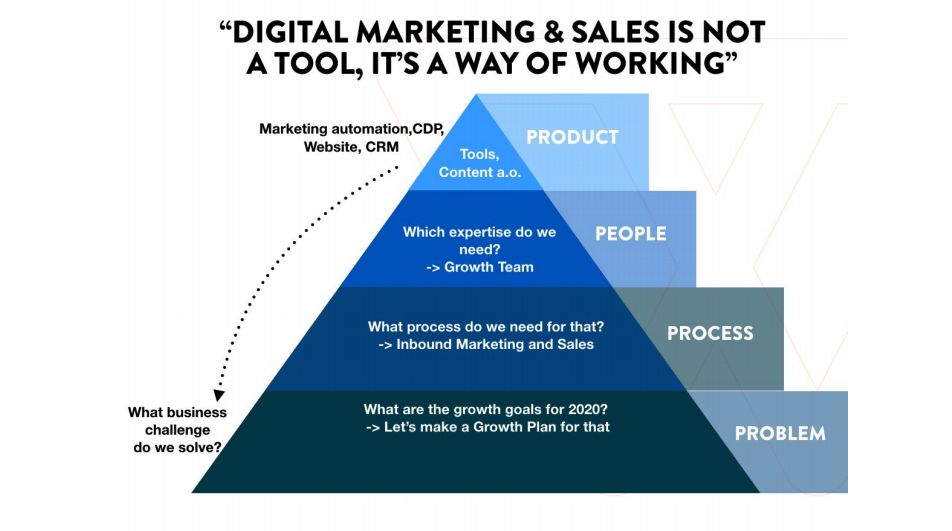
To transform your online marketing, embedding it in the organisation’s DNA is essential. Everyone must be aware that the time has come for change. During the webinar, an example will be given of a company that compared the success of trade fair participation with that of an online marketing strategy. A trade fair requires an investment of around 100,000 euros; the company’s stand attracted 400 visitors, 30 business cards were handed out and, ultimately, five valuable leads were generated. The website and marketing automation cost 40,000 euros. This resulted in 80,000 visitors in a year and generated 2,400 leads (people who signed up for something, requested a quote or downloaded content from them). 280 of those leads resulted in a sales meeting. ‘So,’ the gentlemen conclude, ‘it’s not just a tool, but a way of working.’











