
Most Dutch manufacturing companies are already benefiting greatly from digitisation projects. What do companies see as positive progress and what problems do they still encounter when it comes to digitalisation? An independent survey of 250 Dutch industrial companies commissioned by reichelt elektronik highlights these questions.
The basis for digitalisation is a fast, powerful internet connection. 78 per cent are satisfied with the speed and stability of their connection. At the same time, almost half (44 per cent) believe that a less powerful connection is available at their company than the infrastructure should actually allow. Even more worrying: 41 per cent of those surveyed complain of internet outages at least once a week. In this sense, it seems almost contradictory that people's satisfaction with their internet connection is so high.
Digitisation: Netherlands meets expectations
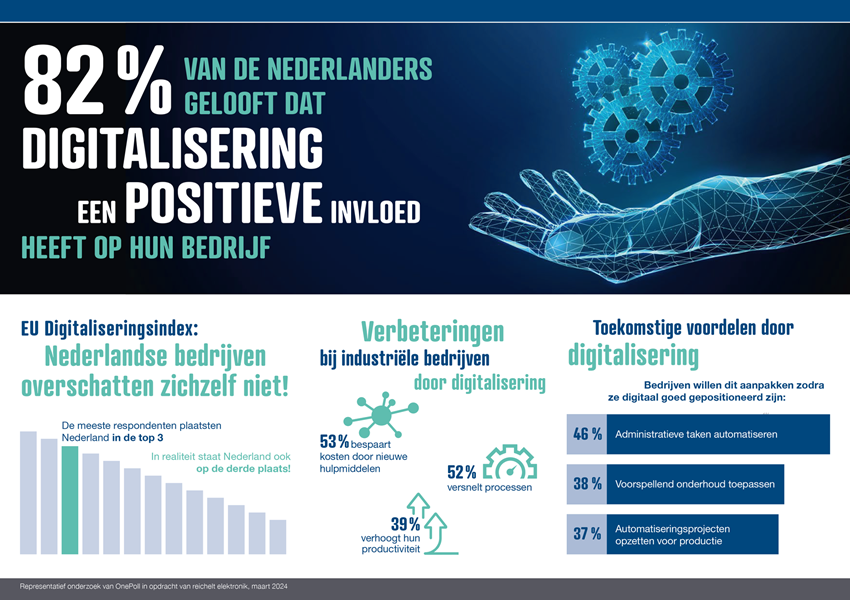
The EU-wide digitalisation index DESI (Digital Economy and Society Index) shows that the Netherlands performs very well compared to other EU countries. In the ranking, the Netherlands ranks 3rd, reasonably well above the European average, trailing only Finland and Denmark. When asked which countries would score best, the Netherlands, Germany and Denmark were mentioned most often. This turned out to be no crazy assessment, with only Germany performing significantly worse, covering 13th place on the DESI index. Dutch companies are optimistic about digitalisation in their country and not unjustifiably so, it turns out.
Efficiency and cost savings
Overall, Dutch manufacturing companies assess their success in digitalisation positively and see great opportunities in it. 82 per cent of those surveyed draw a positive conclusion from their company's digitisation initiatives to date. Companies most value the opportunity to work more efficiently and thus save costs (53%). Speeding up processes and workflows (52%) and increasing productivity (39%) are also frequently mentioned reasons to digitise. When it comes to (digital) tools, companies logically benefit most from equipment such as computers, laptops, smartphones etc. (86%). In addition, the digitisation of administrative tasks (75%) and the use of cloud-based Office applications (75%) are also greatly appreciated. This shows that companies prefer less and less (physical) paperwork in the office.
Accurate metrics
The majority of companies (81 per cent) measure the success of digitalisation using precise metrics such as time to market, error reduction, material savings and profit growth. 41 per cent also set targets before the start of a new project.
Dutch companies also have a clear picture of the opportunities they wish to capitalise on in the future through digitalisation. Which projects would they like to carry out if they were ideally positioned for digitalisation? Most gave the following answers: automating administrative tasks (46 per cent), predictive maintenance (38 per cent) and automating production (37 per cent).
Obstacles
According to almost half of those surveyed, the key success factors for digitalisation projects are finding ways to attract and retain new employees with digital skills (41%). And taking a strategic approach to digitalisation projects so that they integrate better into the company's workflow (40%). The shortage of skilled workers is a particular problem for many companies. Companies see upskilling staff (32%) and more intelligent tools that can fill knowledge gaps (29%) as the most promising approaches to solving this problem. Another 25% also cite more digital education in schools as an approach.
Bureaucracy
There is another challenge: bureaucracy. There is a broad consensus in politics and business that administration in the Netherlands has some catching up to do when it comes to digitalisation. Half of companies (51%) would be willing to handle administrative processes online, such as filling in forms. In contrast, digital services for businesses are not yet sufficiently developed. Only a third (31%) agree that public authorities offer them good digital solutions for performing administrative tasks. Information on bureaucratic processes is also not very accessible and easy to find online, only 35 per cent think so.
Conclusion
If we look at digitalisation in Dutch manufacturing, the picture is layered and complex. On the one hand, companies are achieving good results and looking very positively at their own progress. On the other hand, clear problems keep emerging, such as the shortage of skilled labour.
Image by Gerd Altmann via Pixabay
See also: Dutch R&D investment is lagging behind