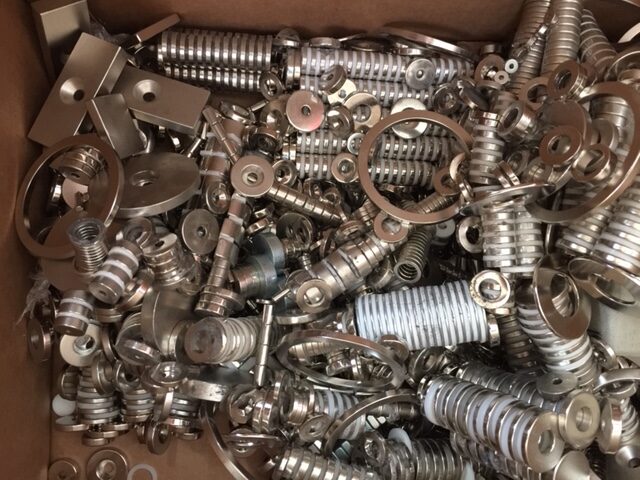

Magnets are valuable components. Various recycling methods for magnets have been developed in recent years. Nevertheless, many magnets still end up on steel scrap. Researchers at the Fraunhofer Institute for Material Recycling and Resource Strategies IWKS give good arguments why this should change in the future.
In their "FUNMAG" project, they show that the use of recycled magnets in the field of e-mobility is possible without loss of motor performance. And that it is worth setting up a value chain for large-scale magnet recycling.
Electromobility
The world is moving towards electromobility. For an electric motor to work, one component must not be missing under any circumstances: Neodymium-iron-boron high-performance permanent magnets. They are the most powerful magnets available on the market today. They account for about half of the motor cost. In addition, they contain rare earth metals such as neodymium or dysprosium, among others. The main supplier of these earth metals is China. Mining often releases toxic by-products, which lead to contamination of groundwater if careless. This harms people and nature.
Functional magnet recycling
Despite this expensive and problematic production, magnets usually end up on the scrap heap at the end of their life. There, remelting takes place along with other steel scrap. A shame, as there are now methods for recycling magnets that have been proven to work. Scientists at the Fraunhofer Institute for Material Recycling and Resource Strategies IWKS in Hanau want to close this gap between theory and practice with their project "Functional magnet recycling for sustainable e-mobility - FUNMAG". The research team wants to prove that electric motors with recycled old magnets can achieve the same performance as with their original new magnets. And that it is therefore worth applying commercial magnet recycling on a large scale. The team receives funding for this from the Hessen Agentur.
Compare
For the experiments, the institute acquired an e-bike, an e-scooter and a hoverboard, among others, says Konrad Opelt, project leader and materials scientist: "For all new vehicles, we first characterised the motor in detail to determine relevant key data. We can then use these to compare the performance of the engines with the recycled magnets."
Large variation
Electric vehicles form the framework of the project. The most important aspect, however, is working with old – scrap – magnets. The researchers can purchase these by the tonne through existing industrial partners, and they vary considerably in terms of power, type and condition. “It was hugely important for us to build a realistic case,” explains Opelt. “When a scrap dealer decides to separate the magnets from their end-of-life engines, the result is usually a hodgepodge of the most diverse magnets, the exact properties of which nobody knows. Our aim was therefore to demonstrate that the recycling process can also handle undefined source material. No one had done this for us before.”
From old to new
Fraunhofer IWKS has been engaged in the production and recycling of magnets for years. With suitable space and equipment, the entire production process can be simulated in a pilot plant. In the production of a new magnet, starting materials are first melted at around 1,400 degrees. They are then quenched, creating metal flakes. These are added to a hydrogen atmosphere. The penetration of the hydrogen causes the material to disintegrate into a granule. This is further ground in a jet mill. The resulting metal "flour" can then be put into moulds and sintered - or "baked" - into magnets. To recycle a magnet, it is enough to bring the old magnet into contact with the hydrogen atmosphere and then follow the remaining steps of the process. "We can simply skip the environmentally damaging extraction of raw materials and the energy-intensive melting process," Opelt summarises.
Quality
The recycling process makes it possible to process thousands of magnets at a time. "It is almost unavoidable that the magnets absorb some oxygen during this process. That leads to a slight deterioration in quality. But we can counter that by adding 10 to 20 per cent of new material, for example. Or by further processing the microstructure of the magnets," Opelt explains. The strength of the recycled magnets can be determined from the final product or at the powder stage. Ultimately, these experiments should make it possible to establish a portfolio of properties. Based on this, future users can make recommendations on how to modify the recycling process. To achieve the desired target characteristics for the magnets based on the output composition.
Optimisation of treatment process
The researchers are currently working on further optimising the treatment process during the recycling process. However, Konrad Opelt is confident that processing the recycled magnets will soon be possible in electric motors.
Building up a value chain
Once this step is taken, it would be tangible proof of the success of recycling. "We want to be able to build a robust value chain for magnet recycling in the long term. For this, all actors in the chain must be able to rely on each other," Opelt emphasises. "With FUNMAG, we are showing that the idea actually works. And that we are making a decisive contribution to building this value chain."
Much interest
Political and business interest in the approach is high. This is because the approach promises both improved sustainability and reduced resource dependence. Konrad Opelt hopes this will encourage manufacturers in the future to think ahead when manufacturing electric motors. In addition, it should ensure that the magnets are easy to remove and reassemble, with recycling in mind.
Outside the e-mobility sector
The same applies outside the e-mobility sector. For all our electrical appliances, from lawnmowers to cordless screwdrivers and mobile phones. They all contain neodymium magnets, which can also be recycled cost-effectively.
Photo and source: Fraunhofer IWKS











