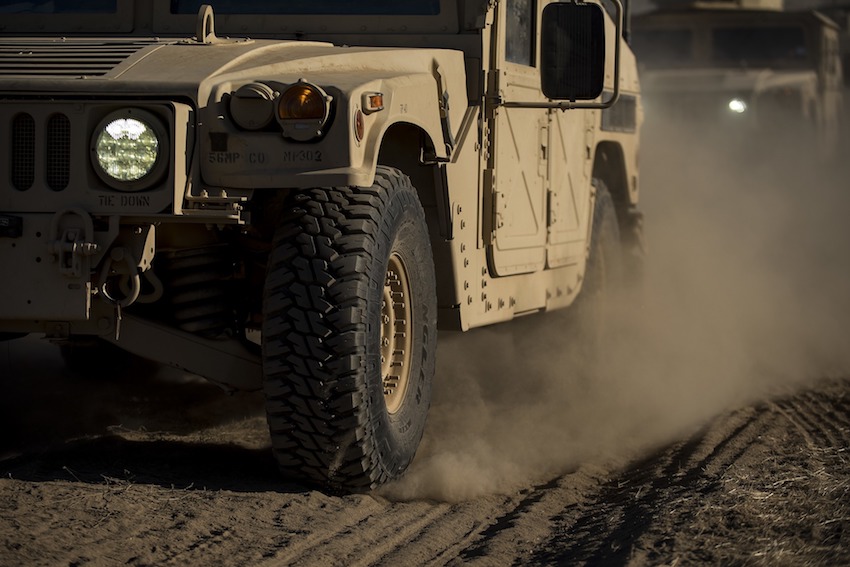

The US military is going to 3D-print vehicles. Vehicles like Humvees can thereby be produced on-site on the battlefield. A deal has been struck for this with the Applied Science & Technology Research Organisation (ASTRO America), which will manage the project.
ASTRO America is a nonprofit organisation that conducts defence R&D activities for the US government. It focuses specifically on using new value-added manufacturing technologies, such as additive manufacturing.
Jointless Hull Project
The nonprofit organisation reports that it has been enlisted for the 'Jointless Hull Project'. This new US Army initiative aims to develop and deliver large-scale 3D printer capable of additive manufacturing in metal. The initiative should not only reduce production speed and costs, but also reduce the weight of vehicles, improve performance and enhance their resilience on the battlefield.
"The mission is to develop a large-scale tool capable of producing a seamless hull for combat vehicles measuring 30ft x 20ft x 12ft," said Larry "L.J." Holmes, Principal Investigator at ASTRO America. "Additive manufacturing on a mass scale has the potential to transform the way vehicles are used for the military, while reducing supplier chain vulnerability."
Monolithic hull
Many combat vehicles use a monolithic hull. This not only makes the vehicle more robust on the battlefield, but also reduces its weight. However, traditional manufacturing processes are not cost-effective or easily adaptable for large-scale production. Especially if different vehicle platforms are produced.
Aaron LaLonde, associated with the US Army's Ground Vehicle Systems Centre and Army Technical Points of Contact (TPOC) for the Jointless Hull Project: "Advanced manufacturing methods that can enable innovative part and concept designs have tremendous value in realising parts, components and ultimately vehicle concepts that give armed forces and systems a leading performance edge. This project scales the benefits of additive manufacturing in metal to a scale that makes the benefits of the technology realisable for larger system-scale parts and enable the next generation of vehicle performance."
Besides ASTRO America, a range of other parties are also involved in the project. For instance, the contract has been subcontracted to LIFT. This is a national institute for manufacturing innovation supported by the US Department of Defence. The Michigan-based U.S. Army Combat Capabilities Development Command Ground Vehicle Systems Center, Ground Vehicle System Center (DEVCOM GVSC) is driving the technical programme. The US Army's Rock Island Arsenal - Joint Manufacturing Technology Center is also involved in the project.
More initiatives around additive manufacturing
The US military is also exploring other possible applications of additive manufacturing. For example, in March, researchers from Penn State's College of Engineering received $434,000 in funding for development of 3D-printed high-strength alloys. Specifically, this involves a Laser Directed Energy Deposition printer that can print in metal. The intended applications are diverse and range from bullet-proof vests to the hulls of naval vessels.
Earlier this year, the US army also signed an agreement with the company ExOne to produce a mobile 3D printer. This printer is housed in a standard shipping container. This simplifies transport and allows installation without specialist knowledge. Among other things, this mobile 3D printer is to be used for the production of spare parts. As part of the contract, ExOne is developing a military edition of its binder jet 3D printing technology.
Author: Wouter Hoeffnagel
Source photo: Pixabay / Military_Material











