
Ships and sails are inextricably linked. For thousands of years, we have been using sails to propel ships. About a hundred years ago, the familiar sails gave way to combustion engines. This made sails really only interesting for recreational sailing.
Emission-free cargo shipping
Combustion engines on board ships are now getting competition from sails after all. Emission-free cargo shipping is gaining traction, which means that sails are now also coming back as an attractive propulsion option. By using advanced materials, computer controls and new designs, sails perform excellently at all levels in this regard.
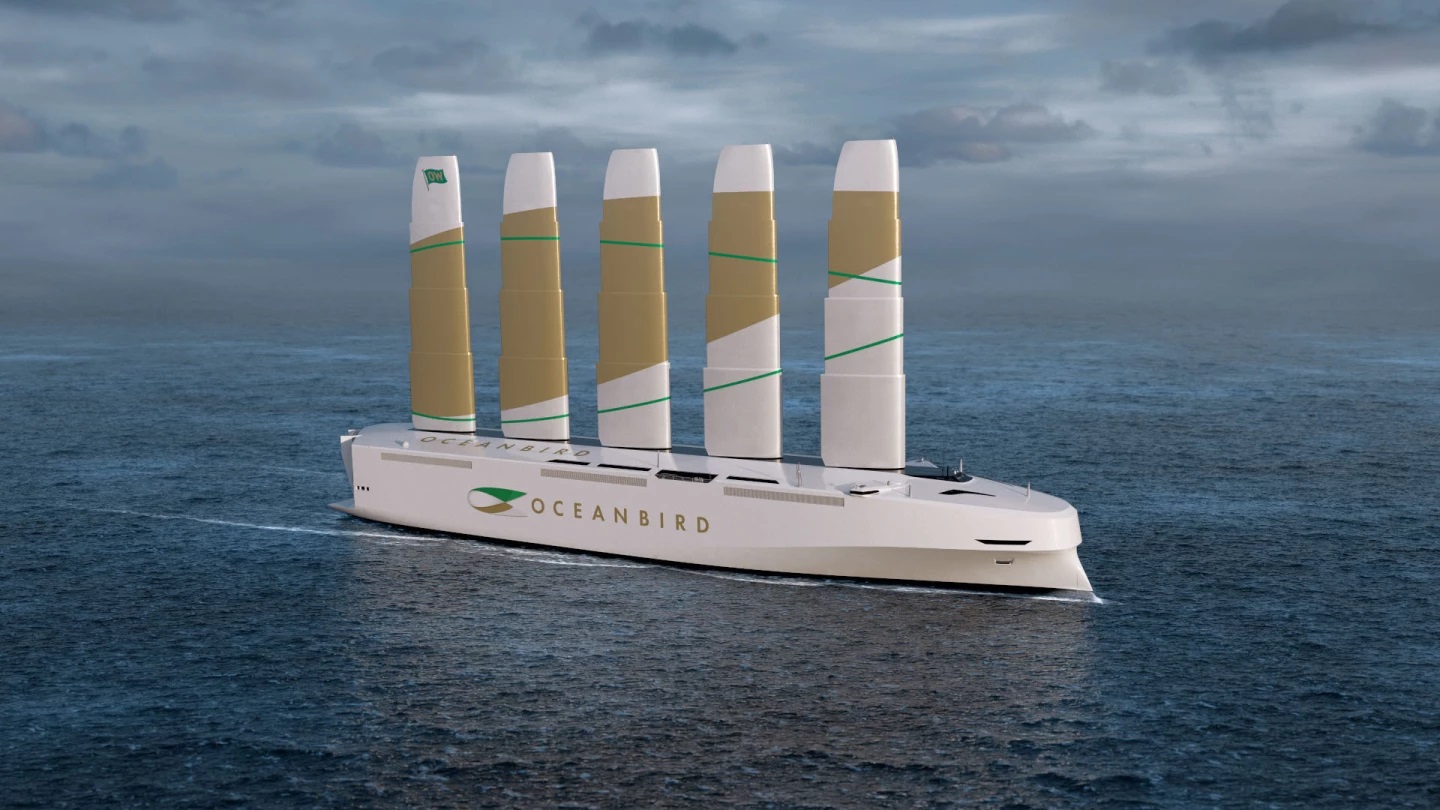
The latest concept is the Oceanbird, a giant freighter that can carry up to 7,000 cars at an average speed of 10 knots. That is not as fast as a conventional freighter but is still quite an achievement. Propulsion is provided by four colossal 80-metre-high extendable wing sails. The Oceanbird's emissions are thus as much as 90 per cent lower than those of conventional cargo ships .
Wing sails
The wing sails, made of metal and composite materials, can be retracted to about 20 m. This allows for normal sailing or passing under bridges even in stormy conditions. Apart from the sails, the Oceanbird still relies on engines for part of its power, if only to manoeuvre well into port or to keep the ship steerable in case of an emergency.
The Oceanbird is a collaborative project between the shipbuilder Wallenius Marine, the Swedish research institute SSPA and the Royal Institute of Technology in Stockholm. The sailing ship has a length of about 200 m and a width of 40 m. Besides cargo ships, the same technology also lends itself to other large vessels, such as cruise ships. For now, it is unlikely to replace container ships. After all, these need the entire deck area to stack containers.
That sailing has its benefits is proven by the figures: commercial shipping contributes about 2.5 per cent to global CO2 emissions and is responsible for 18-30 per cent of nitrogen oxides released into the atmosphere. Commercial shipping also produces 9 per cent of sulphur oxides thanks to cheap, dirty fuel. See what sailing means? The video below gives a nice impression.











