
European standards on CO2 emissions boost sales of electric vehicles (EVs). Despite the COVID-19 pandemic, sales of EVs have surged since 1 January, coinciding with the introduction of emissions standards. It is expected that 10% of all vehicles sold that year will be EVs. By 2021, this percentage will rise to 15%.
This predicts European Federation or Transport & Environment (T&E), a European umbrella organisation for NGOs focusing on transport and the environment. T&E bases its forecast on an analysis of automotive sales figures for the first half of 2020 and carmakers' compliance strategies. The organisation concludes that ambitious CO2 standards are effective in accelerating the embrace of EVs. At the same time, the organisation warns of the lack of clear European targets for 2025 and 2030. As a result, the momentum of EV embrace risks being lost after 2021.
'European manufacturers are back in the EV race'
"Sales figures of electric vehicles are high thanks to emission standards from the European Union. Next year, one in seven cars sold in Europe will be a plug-in. European manufacturers are back in the EV race, but without ambitious 2025 and 2030 CO2 targets to incentivise them, they risk losing steam from 2022," said Julia Poliscanova, senior director for clean vehicles at T&E.
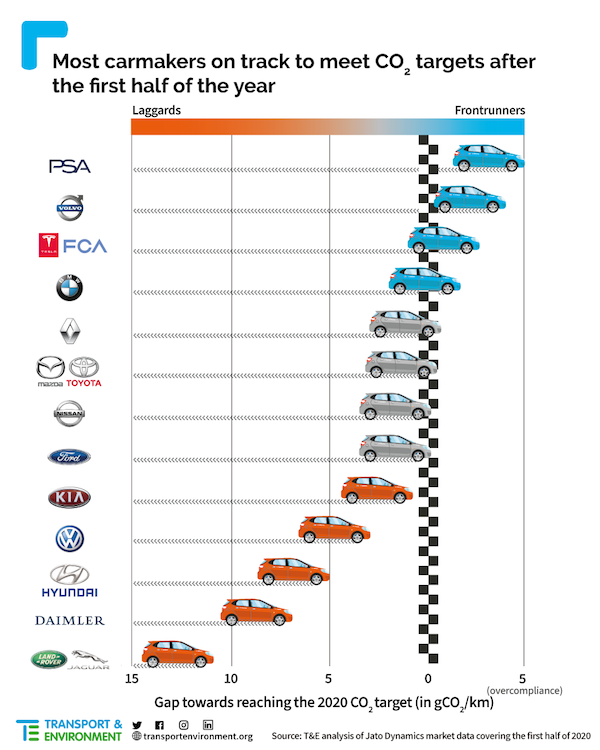
Zooming in on carmakers, PSA Group, Volvo, FCA-Tesla and BMW Group already meet European guidelines for average CO2 emissions of new cars in the first half of 2020. Renault, Nissan, Toyota-Mazda and Ford still have work to do and need to close a gap of about 2 grams of CO2 per kilometre. T&E points out that sales of the Zoe are expected to achieve 15 grams of Renault's average emissions this year. As a result, the French company is also expected to meet European rules by the end of 2020.
Other parties have a bigger gap to close, such as Volkswagen Group (5 grams), Hyundai-Kia (7 and 3 grams respectively), Daimler (9 grams) and Jaguar-Land Rover (13 grams). T&E expects these parties to comply with the guidelines by selling more plug-in hybrids or by sharing emissions with other companies. Daimler, for instance, is expected to sell more plug-in hybrids, including of the E-Class, C-Class, A-Class and GLC.
Momentum at risk of being lost
However, if the EU does not come up with clear European targets for 2025 and 2030, the growth of the share of electric cars in European car sales may stagnate. Whereas the market share is expected to grow from 3% to 10% this year to 15% by 2021, T&E expects it to rise to just 20% by 2025.
As an example of how fast the EV market can grow, the research firm points to Norway. EVs accounted for 6% of cars sold in the Scandinavian country as recently as 2013, while by 2018 the figure had risen to almost 50%.
Sales of SUVs on the rise
At the same time, T&E points to the rising sales of SUVs, which are popular but polluting. 39% of vehicles sold in the EU in the first half of 2020 were SUVs. According to T&E, this is due to a loophole that allows car manufacturers to meet CO2 targets through the sale of relatively heavy vehicles. In addition, the organisation points to the existence of so-called 'fake electric vehicles', which may have an electric motor but are rarely charged in practice. As a result, these vehicles emit two to four times more CO2 during real-world use than during laboratory tests. T&E calls on the EU to set 2035 as the end date for the sale of fuel-engine vehicles.
"The electric car is finally becoming mainstream in Europe, but SUV sales are still growing like weeds. The only way to say goodbye to these highly polluting vehicles is to give car manufacturers a clear end date now. Cars running on biofuels, 'fake' electric motors or fossil fuels that emit CO2 should not be allowed on the market after 2035," Poliscanova argues.
Commercial vehicle subsidies not spent on EVs
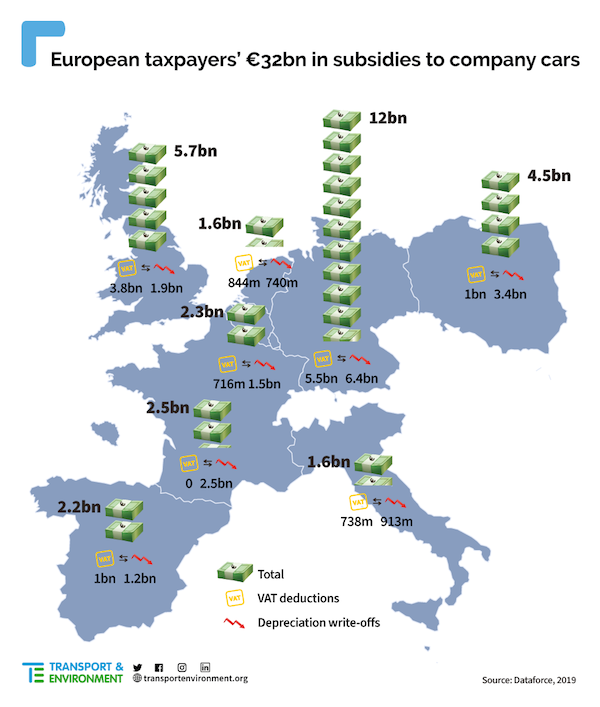
Earlier this month, figures from T&E revealed that subsidies for company cars cost European taxpayers €32 billion annually, while this subsidy is spent almost entirely on petrol and diesel vehicles. For Dutch taxpayers, this cost is around €1.6 billion a year.
The 10 largest leasing companies in the EU account for 8% of total CO2 emissions from vehicles in the EU. This is mainly because leased cars travel on average twice as many kilometres than private vehicles. T&E therefore calls on governments to end tax breaks for combustion-engine business vehicles and encourage companies to electrify their fleets.
Switch is also interesting for businesses
Interestingly, figures from T&E show that a switch to electric vehicles is also financially rewarding for companies. For instance, companies save an average of EUR 4,300 per vehicle per year as a result of this switch. This makes business ownership of an EV 9% cheaper than owning a diesel vehicle. Despite this, 96% of business vehicles registered in the EU in 2019 drive on petrol or diesel.
Saul Lopez, e-mobility manager at T&E, says: "Electric vehicles are already the best choice for business fleets, which have high mileage and where total cost rather than purchase cost is particularly important. However, many company cars come with polluting engines. Why should taxpayers basically subsidise pollution from commercial vehicles when electric vehicles are cheaper to operate?"
Author: Wouter Hoeffnagel








