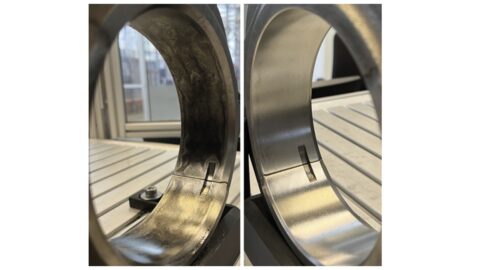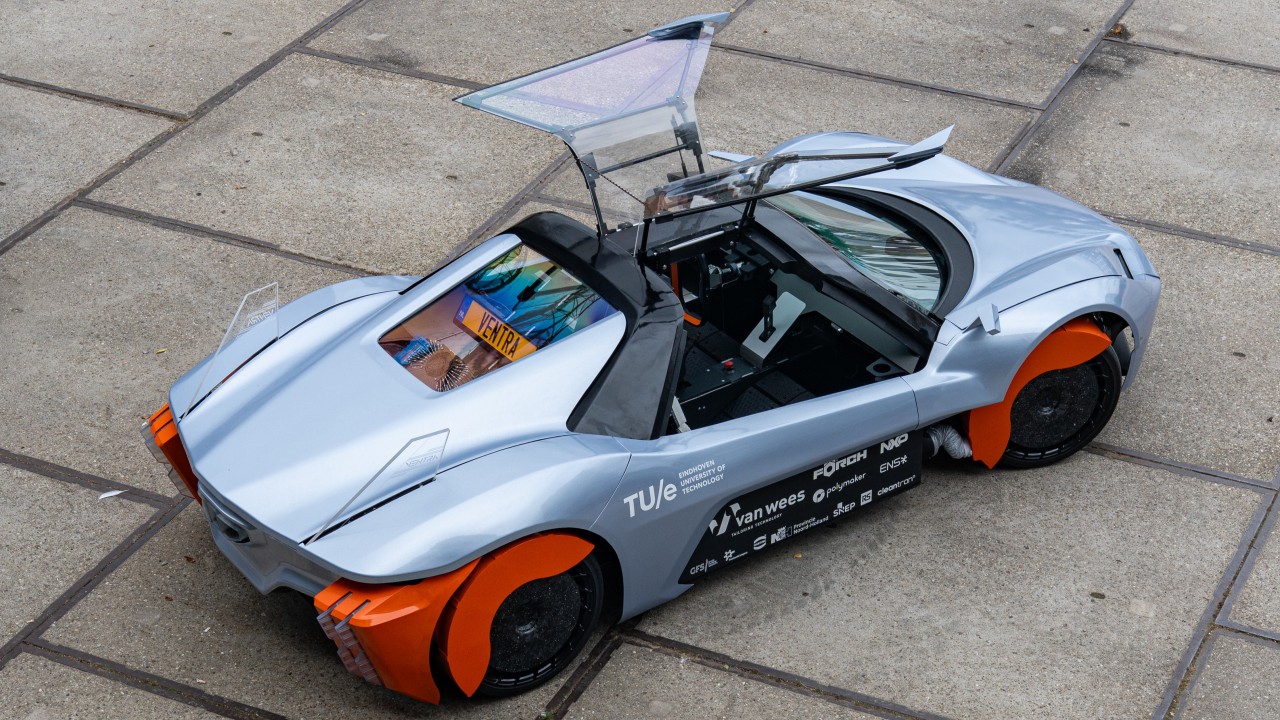

A new electric concept vehicle can capture particulate matter around the wheels whilst driving. This enables it to reduce particulate matter emissions caused by tyre and brake wear.
The system is called VENTRA, developed by the TU/ecomotive student team at Eindhoven University of Technology (TU/e). VENTRA combines a lower vehicle weight, a driver assistance system and an electrostatic collection system to reduce particulate matter emissions caused by tyre and brake wear.
With this vehicle, the student team aims to draw attention to another source of emissions. Although an electric vehicle (EV) does not emit exhaust fumes, particulate matter is still produced by wear and tear on tyres, brakes and the road surface. Figures from the European Environment Agency even show that, in 2023, non-exhaust emissions accounted for over three-quarters (77 per cent) of PM10 emissions and 60 per cent of PM2.5 emissions from road traffic. According to research by Emissions Analytics, the mass of particles from tyre wear can be considerably greater than the amount of particles covered by regulated exhaust emission standards.
Heavy weight and high torque
The weight of EVs also plays a role here. For example, battery packs make EVs heavier on average than comparable cars with internal combustion engines. In addition, electric motors deliver relatively high torque, enabling EVs to accelerate quickly. Both factors cause extra tyre wear.
At the same time, many EVs are fitted with a regenerative braking system, which can reduce wear on braking components. According to figures from EIT Urban Mobility, regenerative braking can reduce brake wear on EVs by around 83 per cent. The figures also show that the higher vehicle weight, in turn, leads to increased tyre wear.
Capturing particulate matter
A key feature of the VENTRA is the T.R.A.C.E. system, which captures particulate matter around the wheels. This system is integrated into the car’s side skirts, with the aim of capturing particulate matter as close to the source as possible.
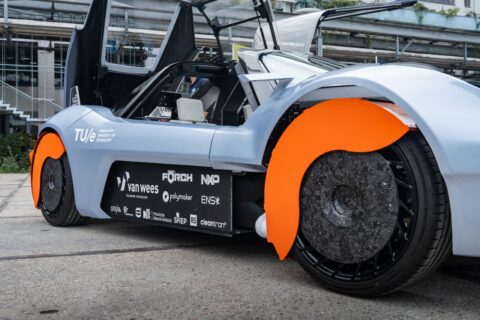
VENTRA by TU/ecomotive (image: Sarp Gürel)
The T.R.A.C.E. system utilises an electrostatic mechanism instead of a conventional air filter. The system imparts an electric charge to fine dust particles and then directs them to a earthed collection surface. There, the particles adhere to the surface and are thus trapped.
Simulations show that at speeds of 50 to 80 kilometres per hour, almost a quarter (24 per cent) of the fine particulate matter emitted by the tyres is directed towards the collection system. At lower speeds, the fans can draw extra air into the system, which, according to the team, could increase this percentage to 42 per cent.
The collection system can be cleaned using a vacuum cleaner or water. If the particles are collected in a dry state, the material can be reused. The team has applied this form of recycling to the interior of the VENTRA. For example, the collected fine dust particles have been incorporated into an enamel coating used to finish parts of the interior.
Low weight
With VENTRA, TU/ecomotive also aims to tackle particulate matter emissions, partly by minimising VENTRA’s weight as much as possible. VENTRA’s chassis weighs approximately 135 kilograms. The monocoque, which consists of carbon-fibre-reinforced thermoplastic sandwich panels, weighs around 45.5 kilograms.
By way of comparison: according to the team, a similar chassis built using traditional production methods would weigh around 230 kilograms. The construction technique used therefore results in a weight saving of almost 100 kilograms.
The total weight of VENTRA is approximately 790 kilograms. Due to this relatively low weight, less force is exerted on the tyres, which in turn reduces wear and tear and, consequently, particulate matter emissions compared to conventional vehicles.
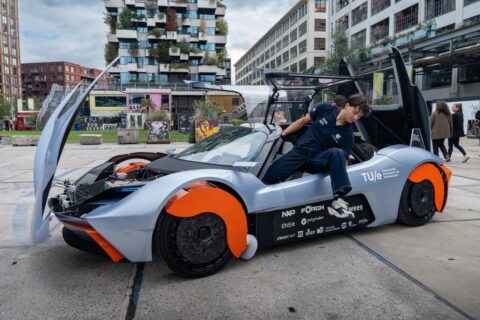
VENTRA by TU/ecomotive (image: Sarp Gürel)
Adjusting driving behaviour
As well as weight, the driver’s driving behaviour also plays a significant role in particulate emissions. VENTRA is therefore equipped with the so-called Clean Drive system, which analyses driving behaviour whilst on the road and provides guidance on how to drive more smoothly. The system helps the driver to accelerate more smoothly, brake less sharply and make fewer unnecessary steering movements. This reduces wear and tear on the tyres and brakes.
The car has a maximum continuous speed of 89 kilometres per hour. According to the WLTP test cycle, the estimated range is approximately 290 kilometres.
Image: Sarp Gürel