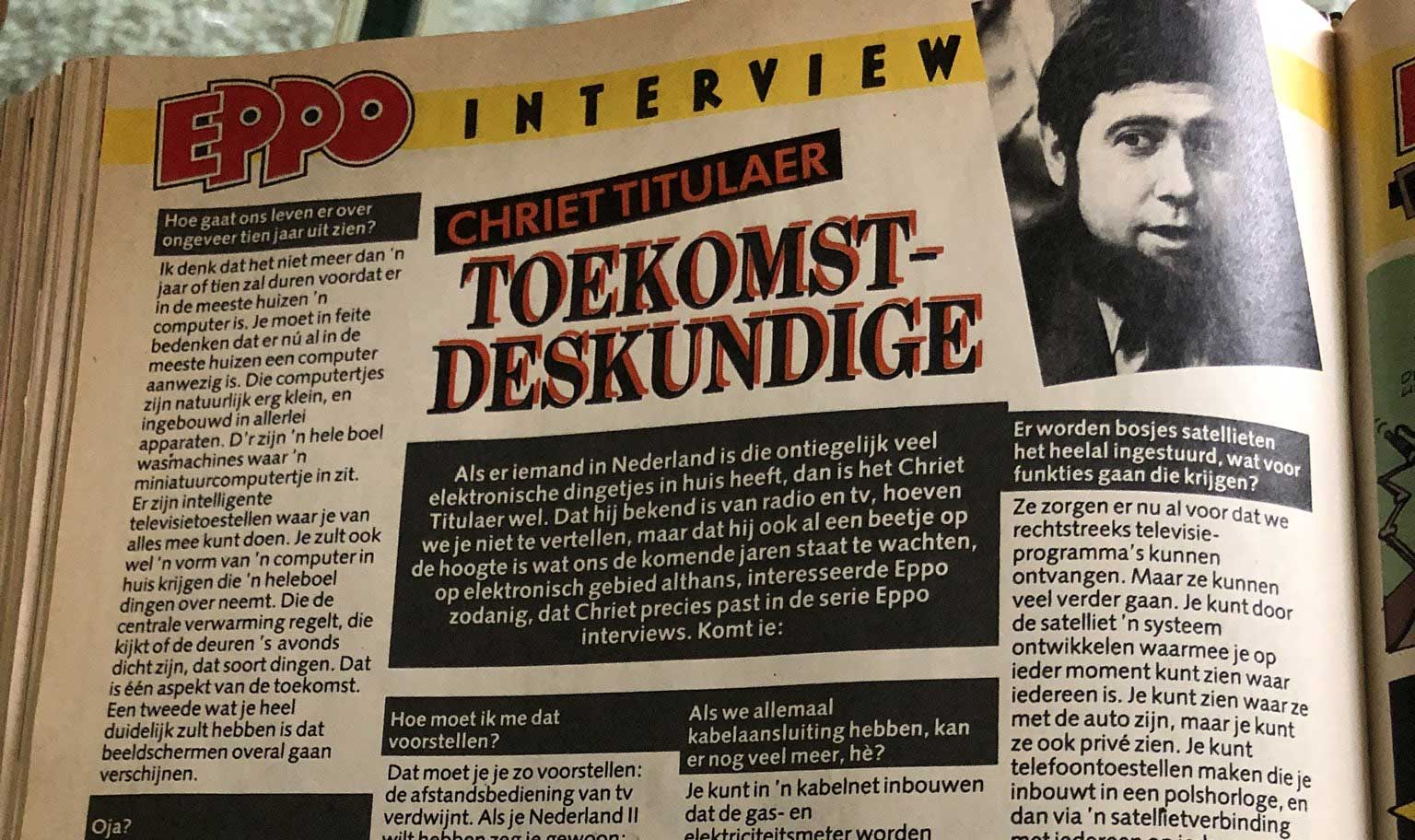

An article from 1982 went around via the departmental app. It concerned an interview with Chriet Titulaer in the comic magazine Eppo. My contemporaries probably remember Chriet (1943-2017). He was an astronomer, popular science writer and presenter of programmes like 'TROS Wondere Wereld'.
I still remember clearly watching the programmes by this Limburg-based scientist with my father. Sometimes we laughed at his predictions, but he was often spot on. For example, in the 1980s, Chriet said: “It’s becoming increasingly difficult to get anywhere by car in the big cities, so we’ll need telecommunications on our bikes.”
Of course, Chriet was sometimes wrong, but many of the visions of the future that he outlined in an accessible way over 35 years ago are now the most ordinary thing in the world.
Back to the present day. It strikes me that (science) researchers in 2020 are still regularly viewed with suspicion. Why? Because their work involves change: ranging from familiar ways of life disappearing to the development of technology we are not yet familiar with. That doesn’t make everyone enthusiastic by any means, and that’s why many people would rather stick their fingers in their ears than listen with interest to what scientists have to tell us.
Can we afford to ignore scientific findings ? The world faces major challenges. Continuing to live, produce and consume as we are accustomed to is causing ever-increasing problems. There are scientists who have been warning us about this for decades and, fortunately, also see solutions.
Time is running out, so you’d expect the government to be only too keen to sit down with scientists (particularly those in the natural sciences). But that’s not the case. Take climate change, for example. Scientific solutions still seem to have barely made an impact on Dutch climate policy. In fact, when the Climate Agreement was drawn up, not a single scientist was present at the Climate Roundtables.
On 19 October 2019, journalist Rosanne Kropman wrote an article on this subject for Trouw with the headline: ‘How science was sidelined during the climate talks’. In this article, she asks what scientific advice Ed Nijpels received during the drafting of the Climate Agreement and comes to the conclusion that science was not even allowed to have a seat at the table. And so it came to pass that the scientific perspective was completely disregarded. The discussions were dominated by ‘stakeholders’, each with their own interests.
When I follow the media, I get the feeling that policies are mostly made for the short term, driven by emotion and not based on scientific insights. And that is a shame. Many contemporary issues can be solved with innovative technology. Fortunately, outside the climate tables, companies and universities are working together on solutions to keep our planet livable for future generations. If we work together to ensure that these innovations are given a stage, there will soon surely be a scientist with expertise at every political table. And if not, a new Chriet Titulaer will soon have to stand up and explain the future to us and politicians in an accessible way. Perhaps a nice challenge for Diederik Jekel or Anna Gimbrère?
Image: Sabine Verschoor (Twitter)