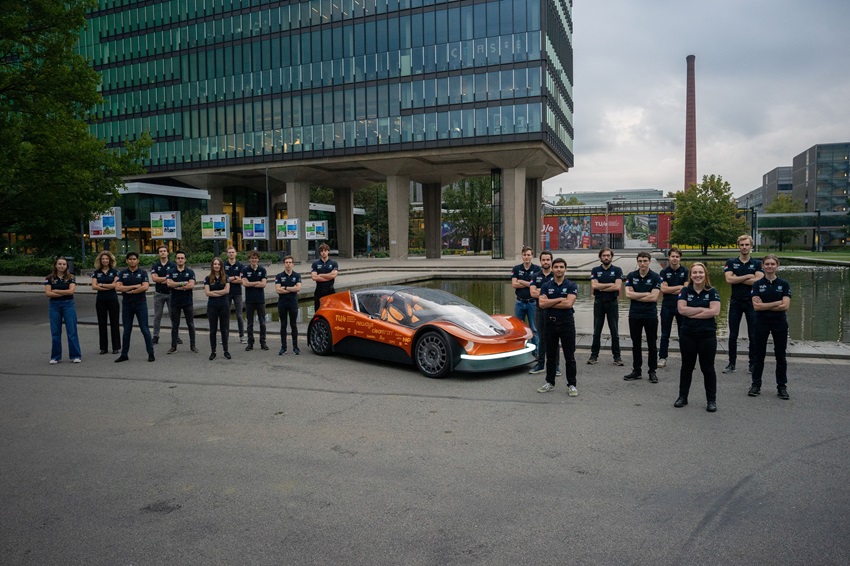

Phoenix is the latest and highly sustainable electric car from students at TU Eindhoven. Through smart assembly and the use of mono-material structures, as much as 75 per cent of the vehicle can be reused in the next generation of cars. For existing cars in Europe, the so-called closed-loop recycling rate is much lower; at only 21 per cent.
Phoenix excels at closed-loop recycling. Closed-loop recycling means that a material can be reused endlessly without significant loss of quality or certain properties. This is different from downcycling. The reuse process currently common in the automotive industry involves turning recycled materials into products of lower quality or with reduced functionality. This usually happens because the recycled materials are mixed with other materials. As a result, reuse in their pure form is not possible.
More than six million vehicles
Although the sector organisation Auto Recycling Nederland (ARN) reports that 88 per cent of car materials are reused, the majority of these materials end up outside the automotive sector due to a loss of quality during downcycling. These materials are then processed into products such as pens and clothing. In Europe, more than six million vehicles are scrapped every year. This results in millions of tonnes of waste. Improving the recycling process across the board is beneficial. It can help to mitigate serious environmental problems and preserve large quantities of valuable materials.
Phoenix
Student team TU/ecomotive aims to achieve the highest possible closed-loop recycling percentage with Phoenix. In doing so, materials can be recovered and reused in their original state in new products of the same nature. With Phoenix's smart design, they succeeded in doing so. The students thus set a new standard for a circular economy and better recycling within the industry, preserving valuable materials.
Monomaterial structures
The secret lies mainly in the mono-material structures. A minimum variety of materials is used. There are also clever fastening methods where the materials are not permanently connected to each other. As a result, the quality of the materials deteriorates less after reuse. Recycling efficiency increases.
Optimal battery life
In addition, batteries are generally difficult to reuse. Therefore, it is important to optimise battery life. The team achieved this by integrating both fixed and removable batteries into the car. The removable batteries are only used for long distances. They can increase the driving range by more than 60 per cent. Moreover, the batteries can also be used to charge electrical appliances at home when the car is not in use. Because the removable batteries are less intensively loaded, they last longer.
Brussels regulations
With Phoenix, the TU/ecomotive student team is also responding to changing regulations from Brussels. Indeed, a new regulation from the European Commission aims to ensure that circularity in the automotive industry improves in design and production. It requires vehicles to consist of a set percentage of 25 per cent recycled plastic. Of this, 25 per cent in turn must be closed-loop reused from cars. So this means that the total amount of closed-loop recycled material should be 6.25 per cent.
Step in the right direction
Although this percentage could be even higher, students say this is a step in the right direction. "The European Commission is setting the right course. But more is needed to really transform the industry," clarifies Tim van Grinsven, TU/ecomotive team manager.
Van Grinsven explains that the team's goal is to inspire the automotive industry to design more sustainably. "The earth does not provide unlimited resources, so more efficient use of materials is the solution. Phoenix is our answer to that. And we invite the industry to join us in this challenge."
Source: Eindhoven University of Technology Photo: Phoenix is the latest and highly sustainable car from TU/ecomotive Photo: Sarp Gürel








