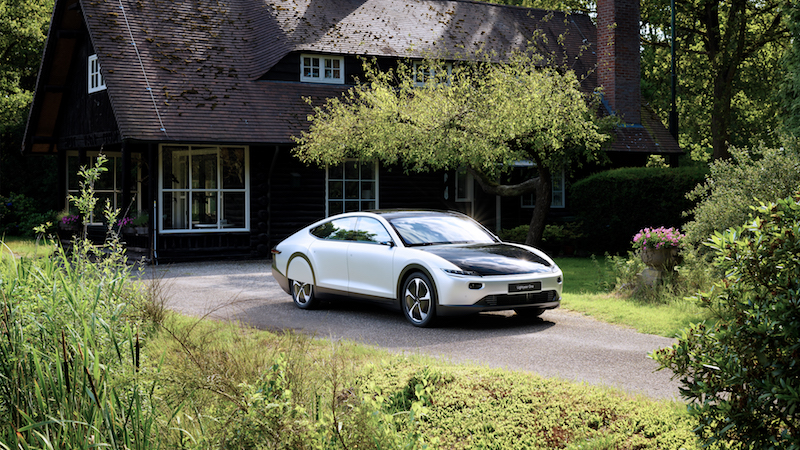

Scale-up Lightyear's Lightyear One electric car is fitted with tyres specially designed for it by Bridgestone. The vehicle will be launched at the end of this year.
Lightyear is a Brabant-based company founded by some alumni of Solar Team Eindhoven. This team won the Bridgestone World Solar Challenge in both 2013, 2015 and 2017 using their solar car. This solar car was the inspiration for the Lightyear One, a production vehicle that runs (partly) on solar energy.
Solar roof
Lightyear One is known, among other things, for its special roof, which incorporates solar panels. These allow the vehicle to continuously recharge its batteries without the need for a charging station. This increases the Lightyear One's range; Lightyear promises a WLTP range of 725 km.
Design cuts down on users' charging requirements. By using its built-in solar panels to top up and recharge the vehicle, a charging station is needed less often. In practice, this means users are less dependent on charging infrastructure.
Charging via solar or grid
Lightyear claims that customers can travel 7,000 to 20,000 kilometres per year for free and using renewable solar energy. Using solar energy, the vehicle charges to reach 12 kilometres in 1 hour.
However, it is also possible to charge the vehicle via the electricity grid. Via a 230v socket, a power of 3.7 kW can be charged. This translates to 35 kilometres of range per hour. A 22 kW public charging station increases this to 209 kilometres per hour and a 60 kW fast charger to 570 kilometres per hour.
Tyre with low rolling resistance and low weight
To support the Lightyear One's performance, the scale-up sought a tyre with very low rolling resistance and lighter weight. Among other things, this helps to extend battery life, increase battery radius and reduce environmental impact.
Bridgestone developed the Turanza Eco tyres for Lightyear. These combine the company's lightweight ENLITEN and ologic technologies for the first time. These technologies reduce weight by using fewer raw materials during the manufacturing process. A different tread, larger diameters, higher inflation pressures and a slim design also contribute to reducing rolling resistance.
Weight saving of 10%
gain from these tyres is equivalent to a weight reduction of over 90 kg. The total tyre weight per vehicle has been reduced by 3.6 kg, equivalent to 10%. With no concessions on mileage or grip, reports the manufacturer.
Bridgestone used a technology called Virtual Tyre Development in developing the tyre. This technology enables digital modelling of a tyre's performance. This cuts mileage during outdoor and tyre testing by 40,000 kilometres. This reduces product development time by up to 50%.
Author: Wouter Hoeffnagel
Source photo: Lightyear








